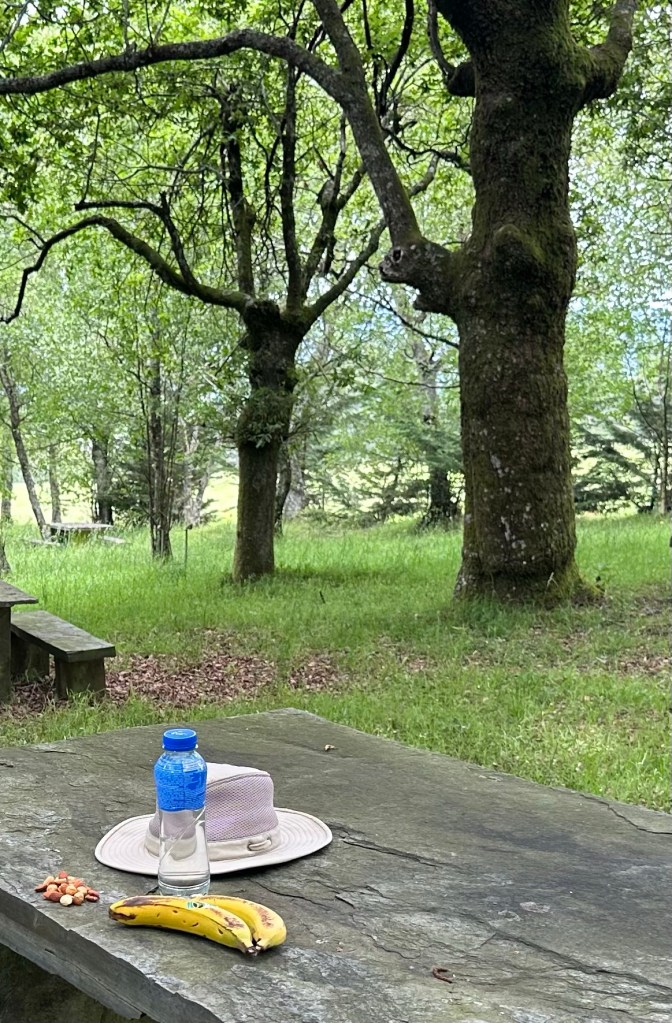
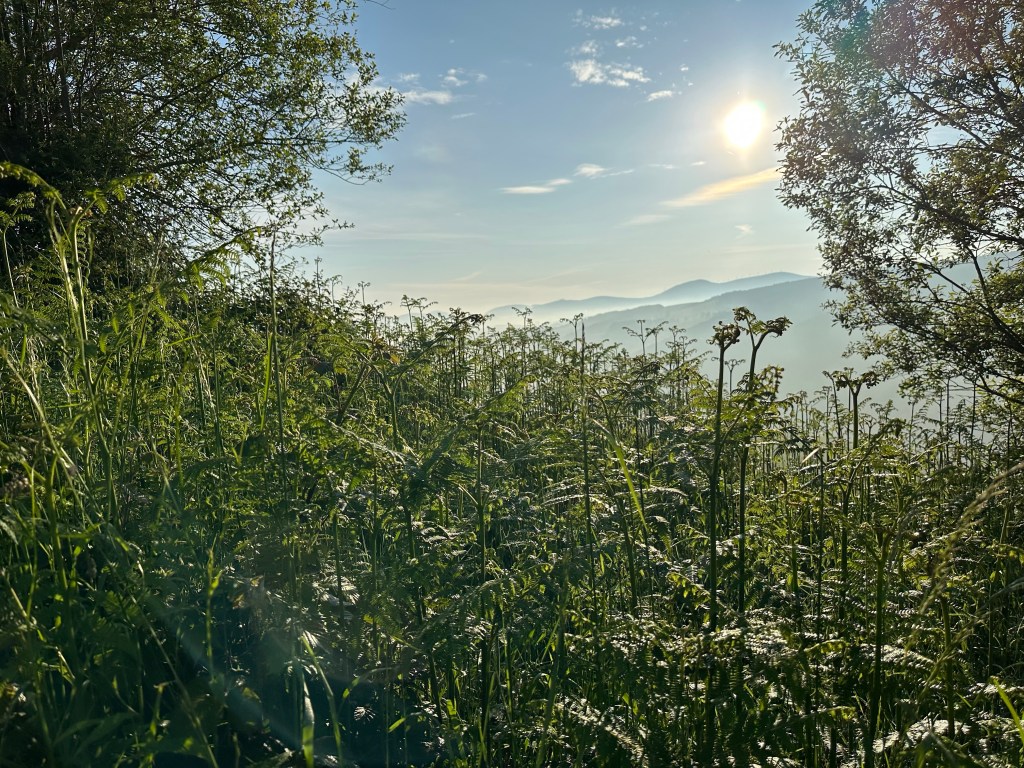
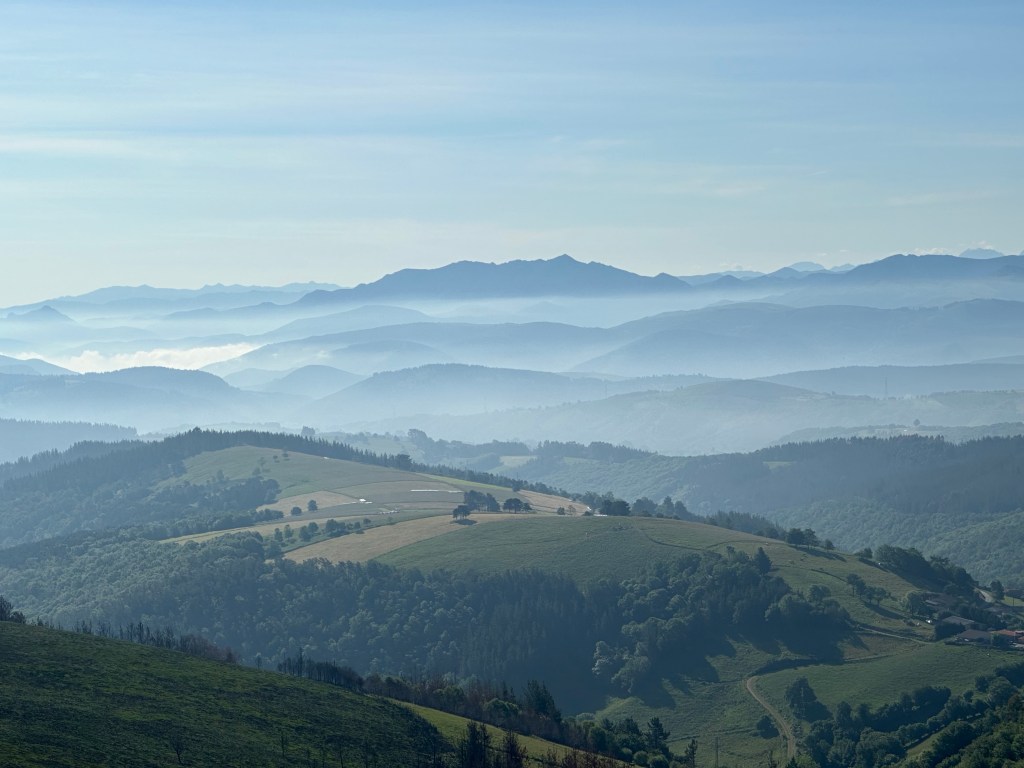
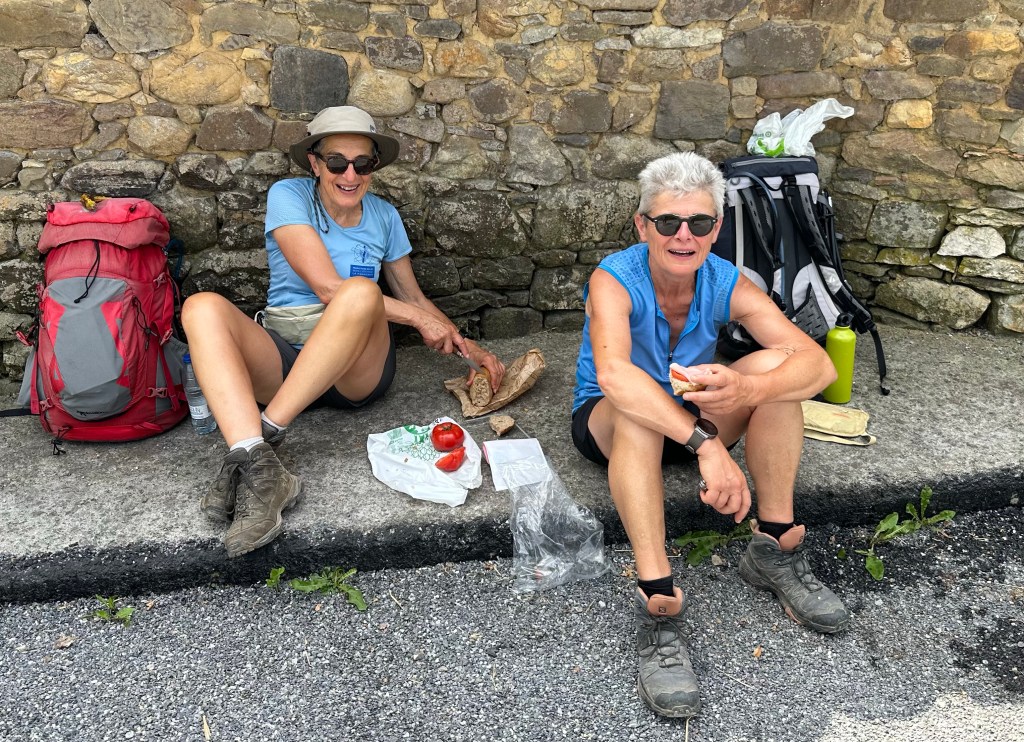
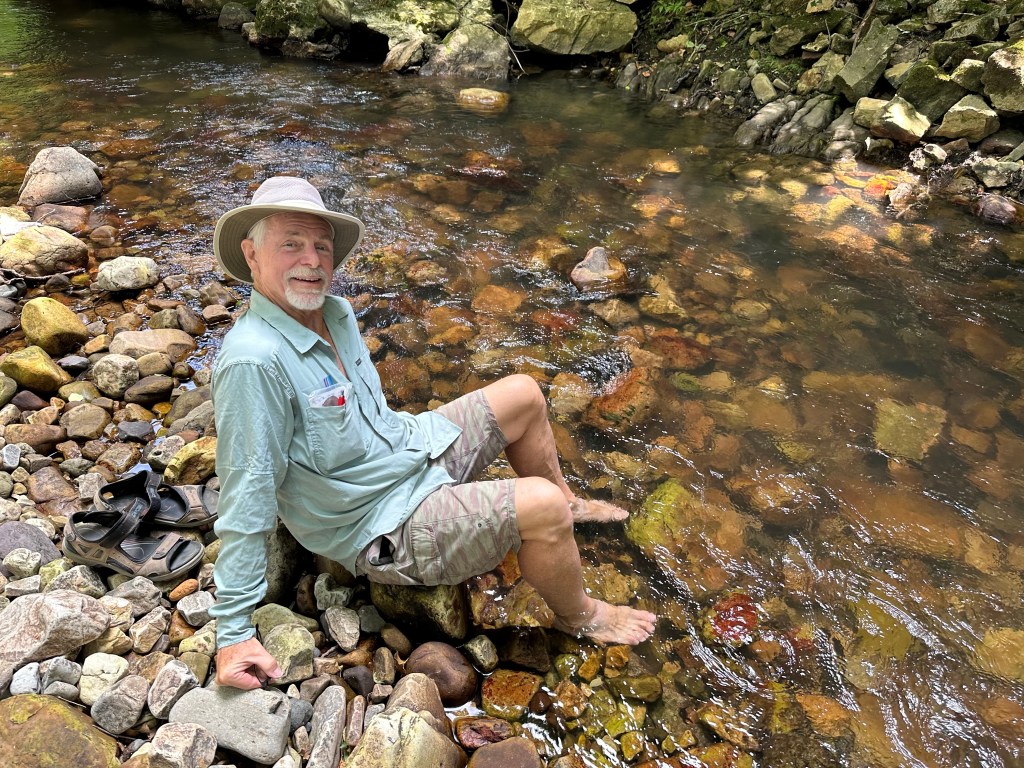
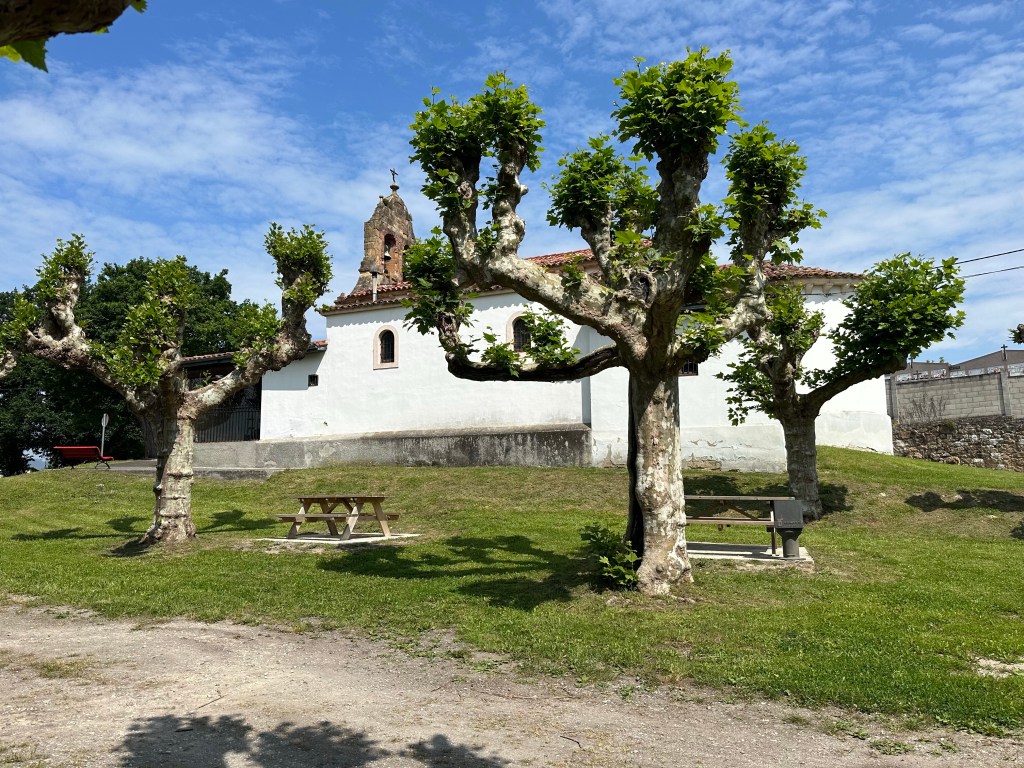
Today was a beautiful day for hiking as the sun came up shining in a blue sky. The valleys were full of fog, but most of today was above it all. The trails were good and well indicated with a minimum of asphalt. The ascents and descents were all manageable and I took it easy during the last 5 miles or so, detouring to Vilabade to catch the 15th century Iglesia de Santa Maria, considered a historic treasure. I stopped for a breather and a snack on the spacious grounds surrounding the church. There were also some other interesting historical sites along the way.
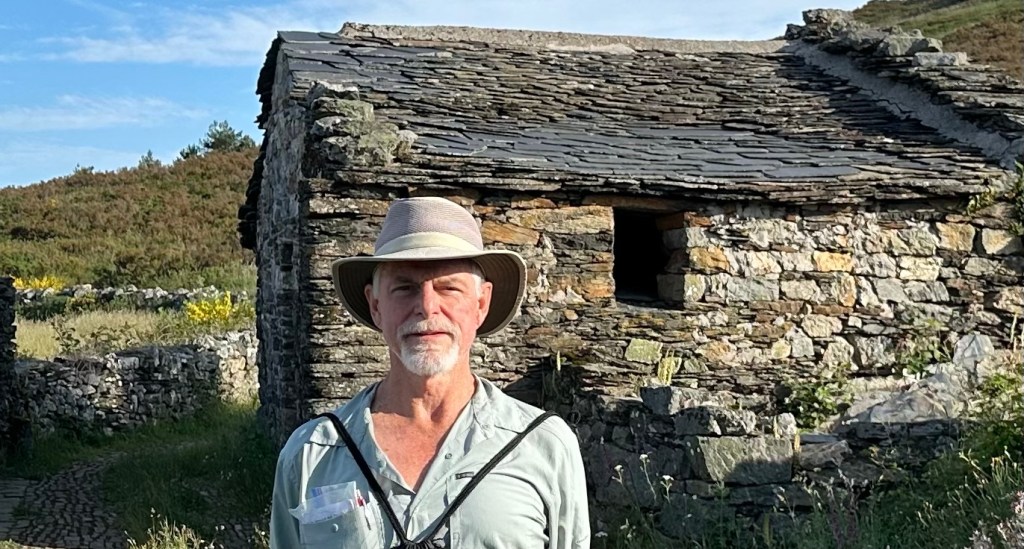
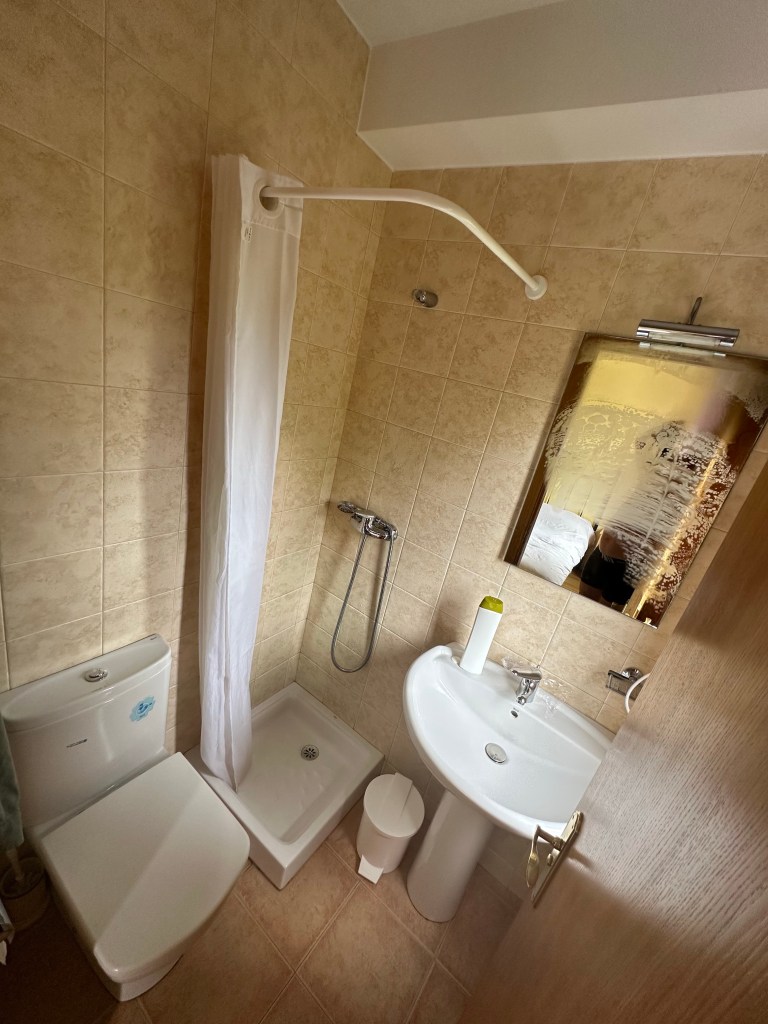
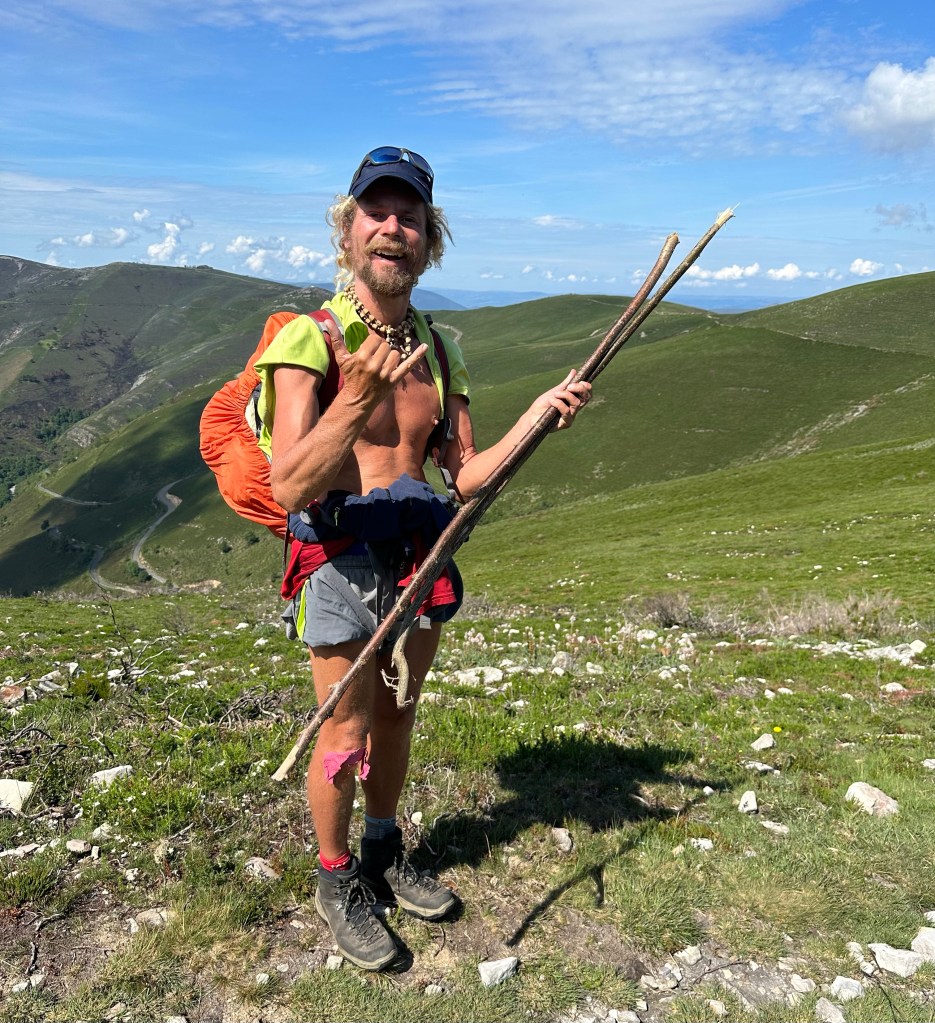
I am standing in front of the 14th century Hospital de Montouto which was open and housing pilgrims until just after the Spanish Civil War. I also walked by an ancient hamlet of stone buildings with thatched roof, or palloza, near Paradavella. I stopped for a snack in Vilabade, an upscale village of nice country homes. The trail then led into Castroverde, my destination for today. Upon arrival at the Pension Cortes, I was shown my room. I cleaned up in the world’s tiniest shower!
The afternoon thundershowers did not strike until about 5 pm today, a couple hours later than in the past few days so I had a bit of sunshine to dry my little pile of laundry and enough left over to sit in the hot sun and relax from the day’s efforts. It was about 21 miles and, according to my health app, I climbed the equivalent of 163 floors. That would be like walking up all the floors of the Empire State Building, taking the elevator down and walking up to the 61st floor.
Rain is forecast pretty much all day tomorrow so I am not sure I am going to do.
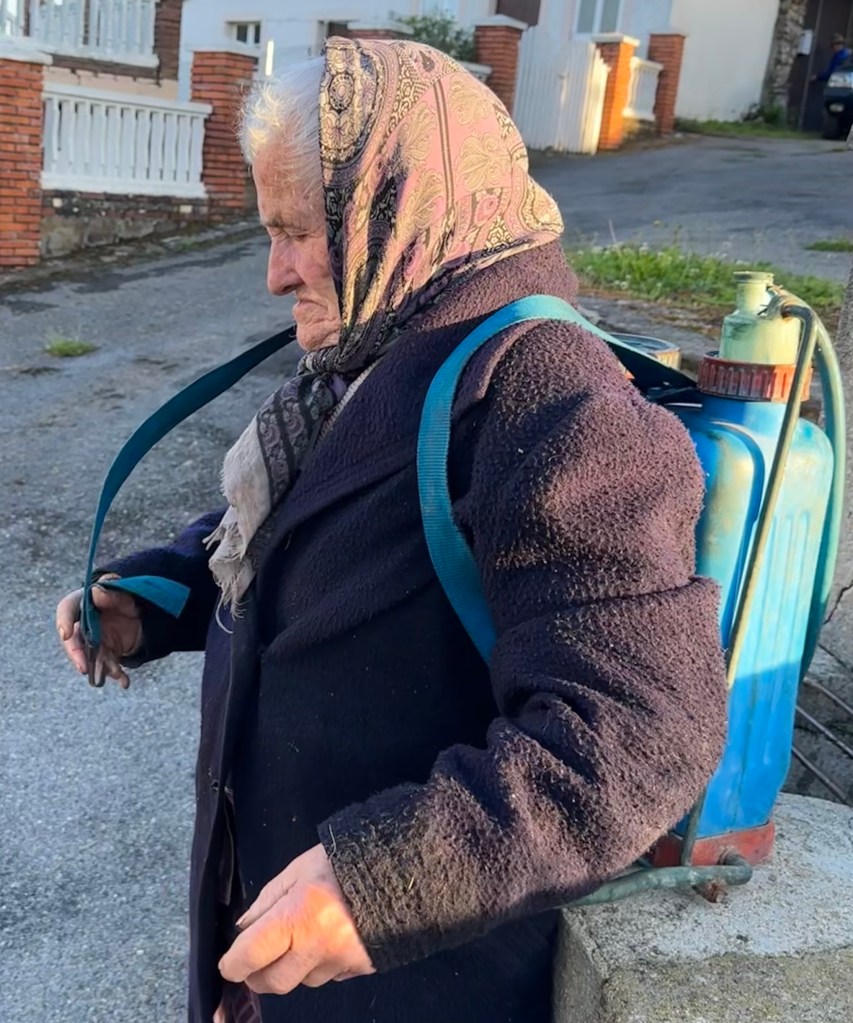
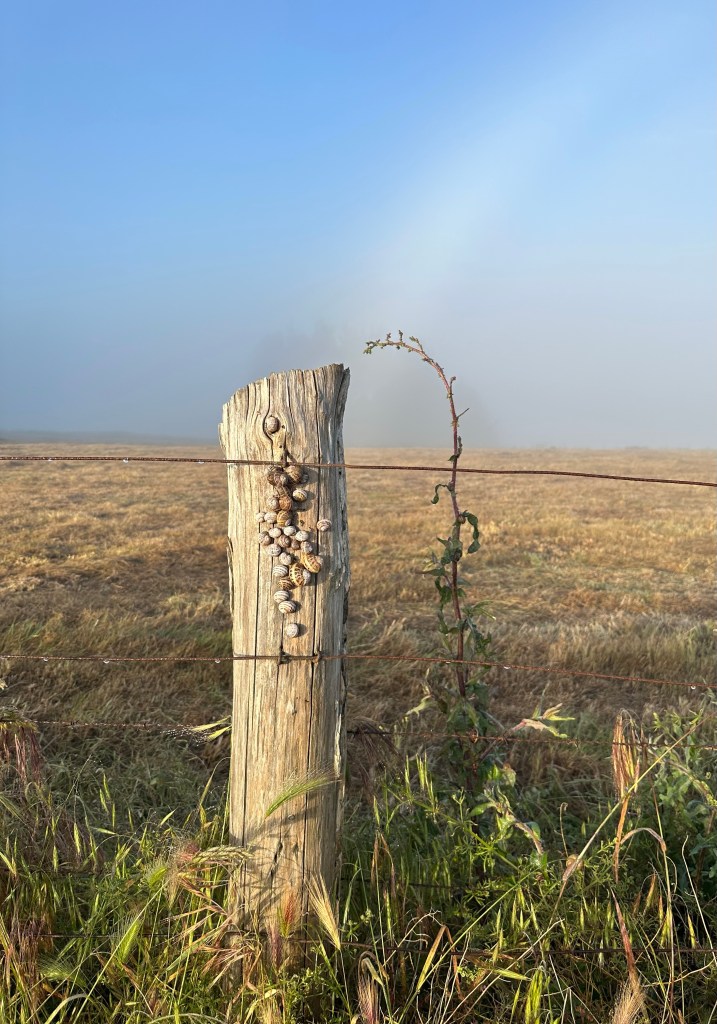
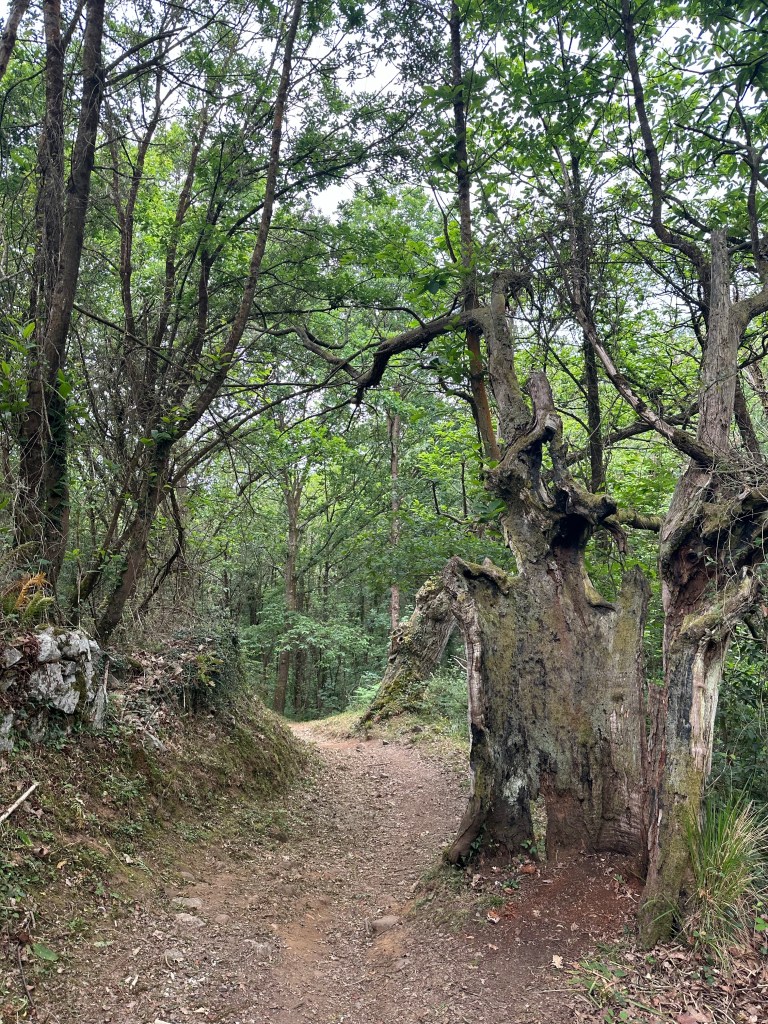
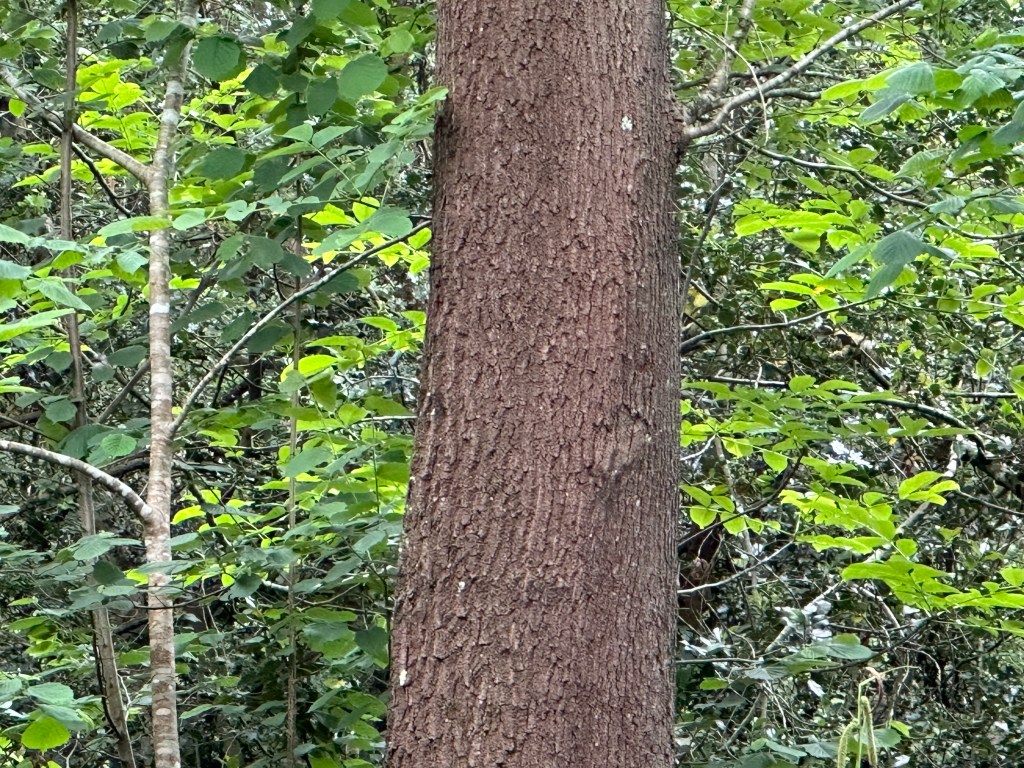
I met this woman early this morning on the way out from Fonsagrada. She filled her can full of water. She told me she had to water her potatoes. This is the woman’s potato plant – just kidding! How many faces can you see in the gnarled trunk?
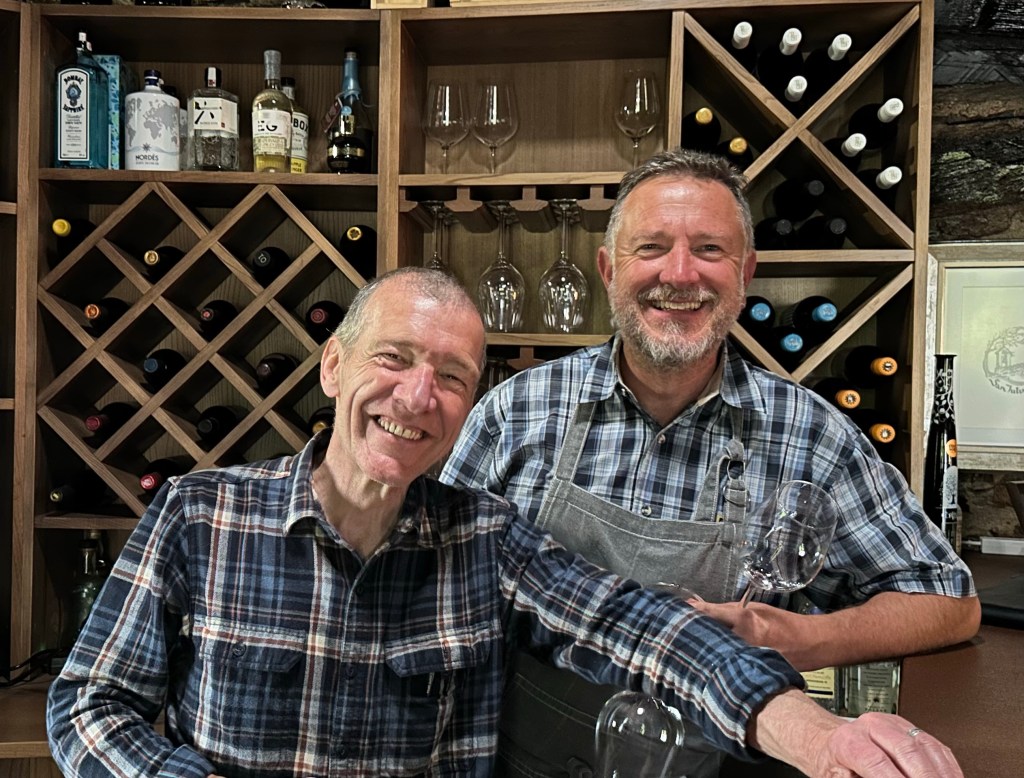
Sean and Mynhardt treated us to a nourishing and filling breakfast of granola and yoghurt followed by coffee and croissants with homemade jam and marmalade. They served orange juice as well but it was not freshly squeezed as it is in many of the cafe bars along the way. The goodbyes were long and the good wishes heartfelt.
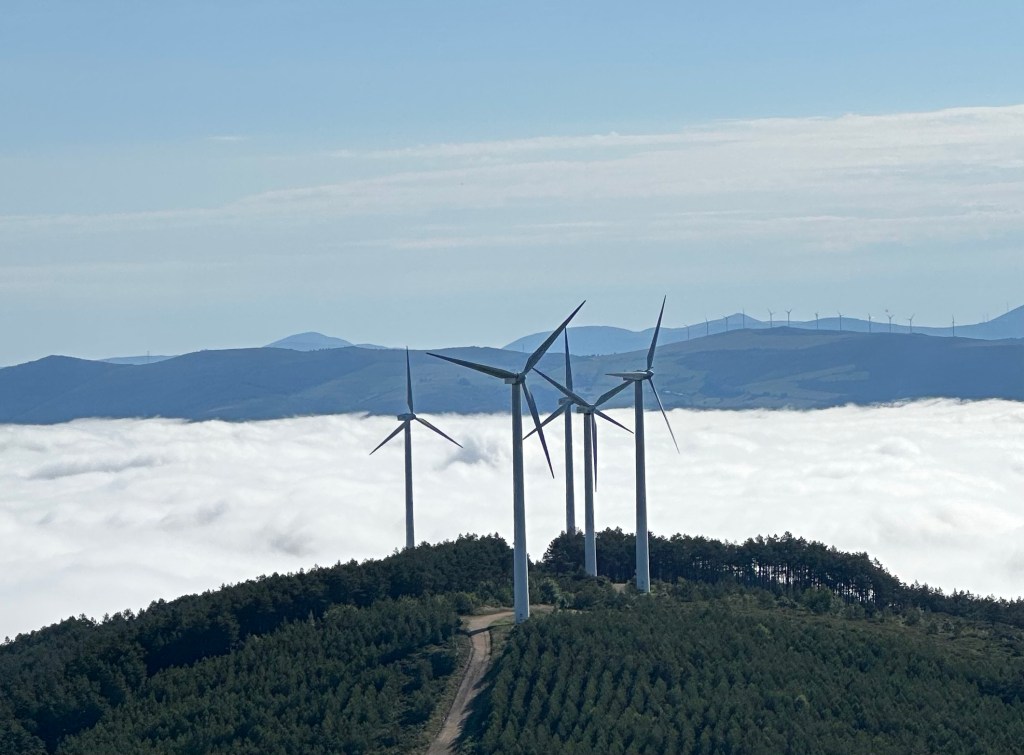
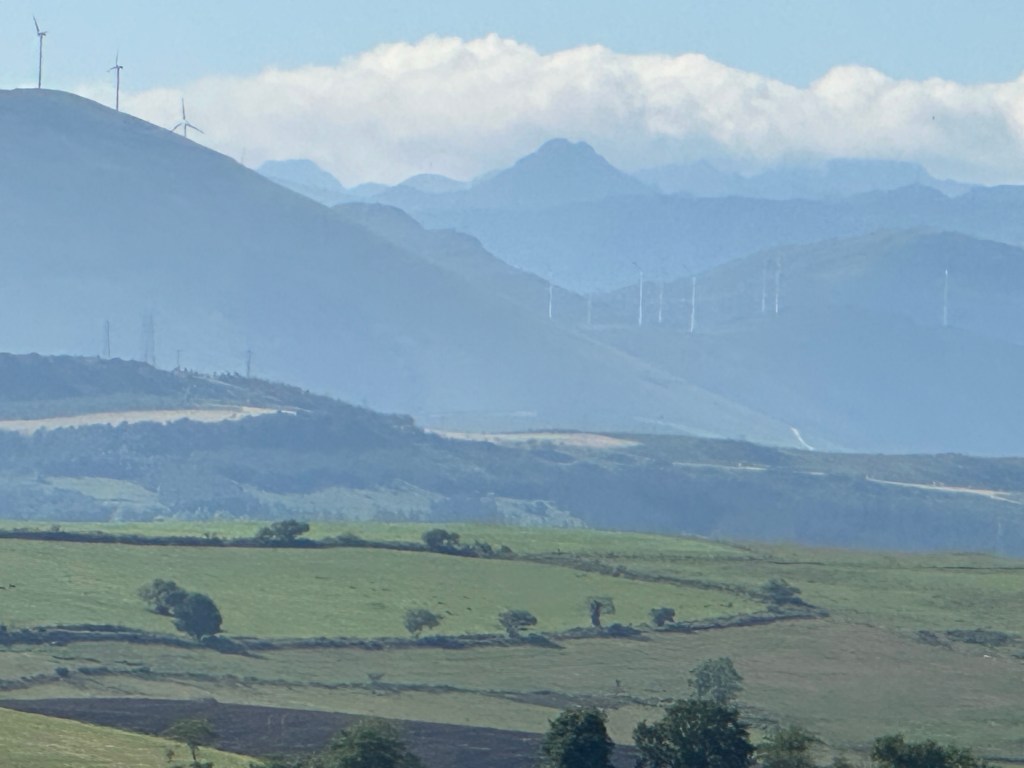
The walk started with a steep climb through a thick morning fog. Breaking through the fog revealed more wind turbines. This was a shorter day than average, but the ascents were very steep, especially the final killer climb into Fonsagrada.
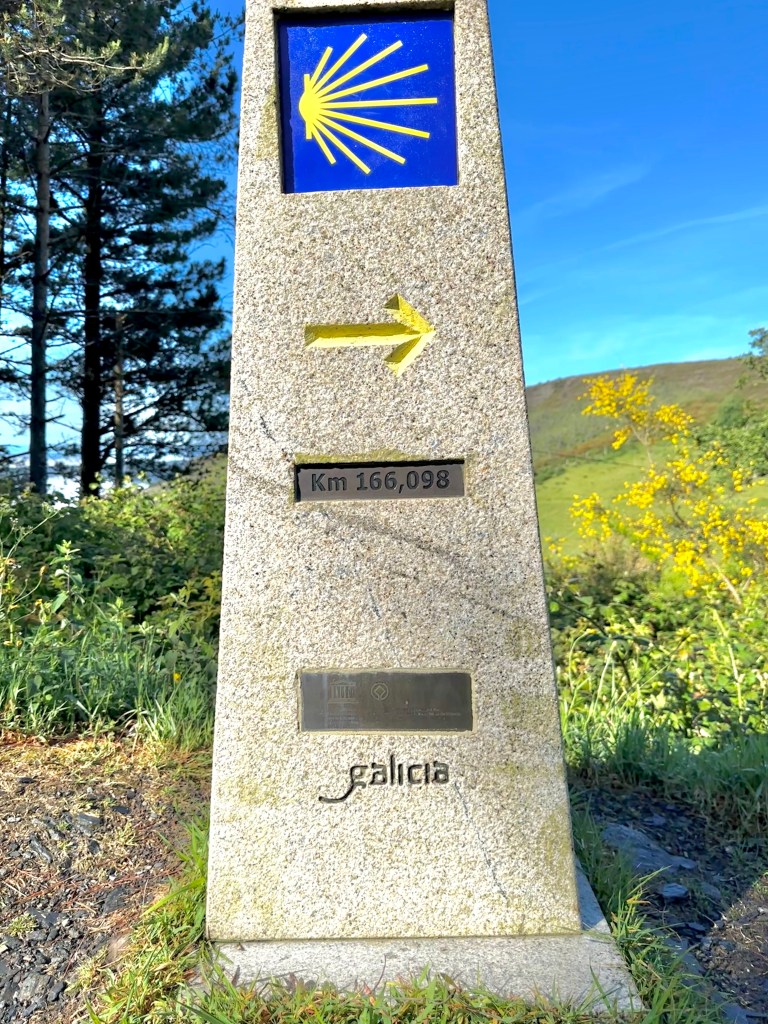
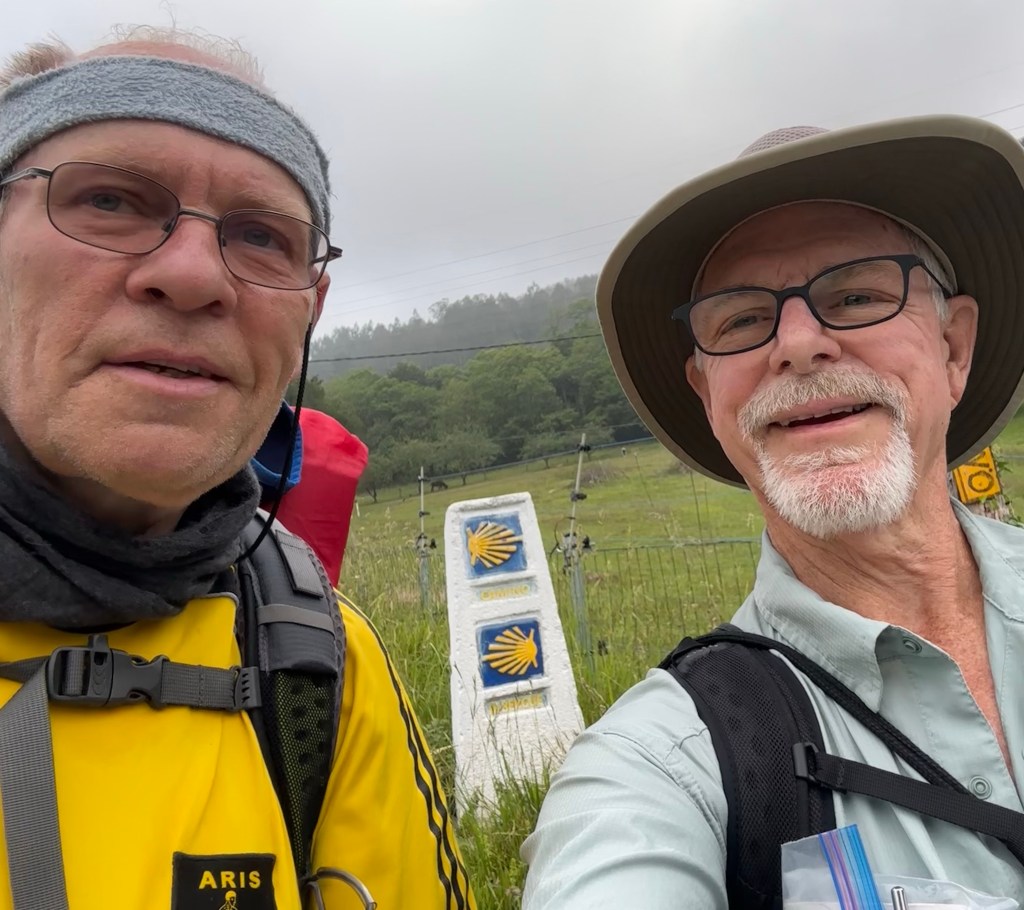
Half-way or so through the days trek I crossed over from Asturias into Galicia. I also passed by a marker indicating 160 km to Santiago. That would mean less than 100 miles to go to complete the Primitivo.
In Galicia!
I was happy to arrive early to take care of some planning for the final days of the pilgrimage when reality derailed my plans. I had planned to arrive in Santiago on June 11, take a train to Madrid on June 12 and head back to Houston on June 13. However, the only train I could get booked on leaves Santiago June 10. A bus would take 10 hours and I will not do that. Flights on RyanAir started at 250 euros. I did not want the hassle of renting a car. The earlier departure meant changing hotel bookings which were already getting difficult. Funny how best laid plans can run amok!
Twenty plus miles tomorrow, with nearly 2900’ of total ascent, so I will keep this short. Goodnight from Galicia!
Alberge Miguelin is in the village of La Mesa which sits at the base of a hill atop which the giant air foils of a dozen or so wind turbines slowly rotate. I could hear the soft and distant whirrin whirrin whirrin of the blades as I fell asleep. I thought about my home in California where, when the wind is right and the waves are strong, I can hear the muted crashes of swells meeting land through the open window of our bedroom.
Not every morning, but most, I give thanks for being alive. As I set off on my daily journey, I call to mind all that I am thankful for. I am thankful for Paula, who understands this quixotic need of mine to travel to a distant place and walk for hours. I am thankful that I have three wonderful sons, born of the love between me and Paula, and pray that each of them can find a joy such as I have found in them. I am thankful that I grew up with a loving mother and proud father and six great sisters each of whom amaze me in the lives that have been bestowed upon them. I have a wonderful daughter-in-law and three beautiful grandchildren. I have been blessed with great friends, teachers and masters. I am blessed beyond what any man could expect. And I am truly thankful for all of that. And it all begins with being alive.
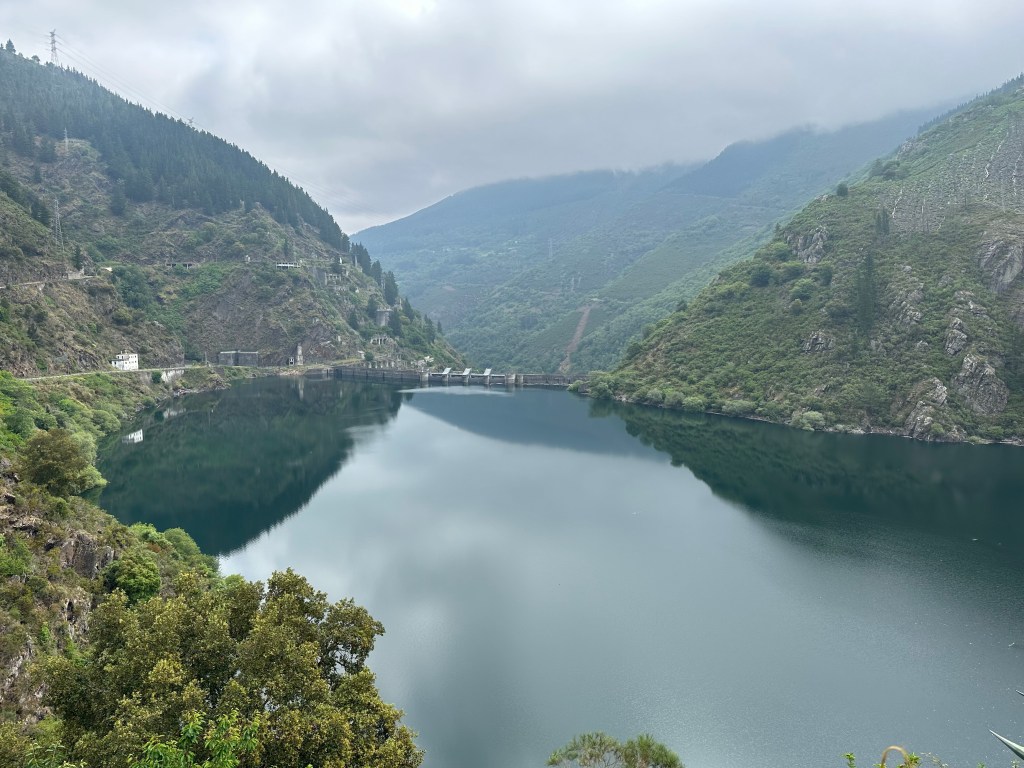
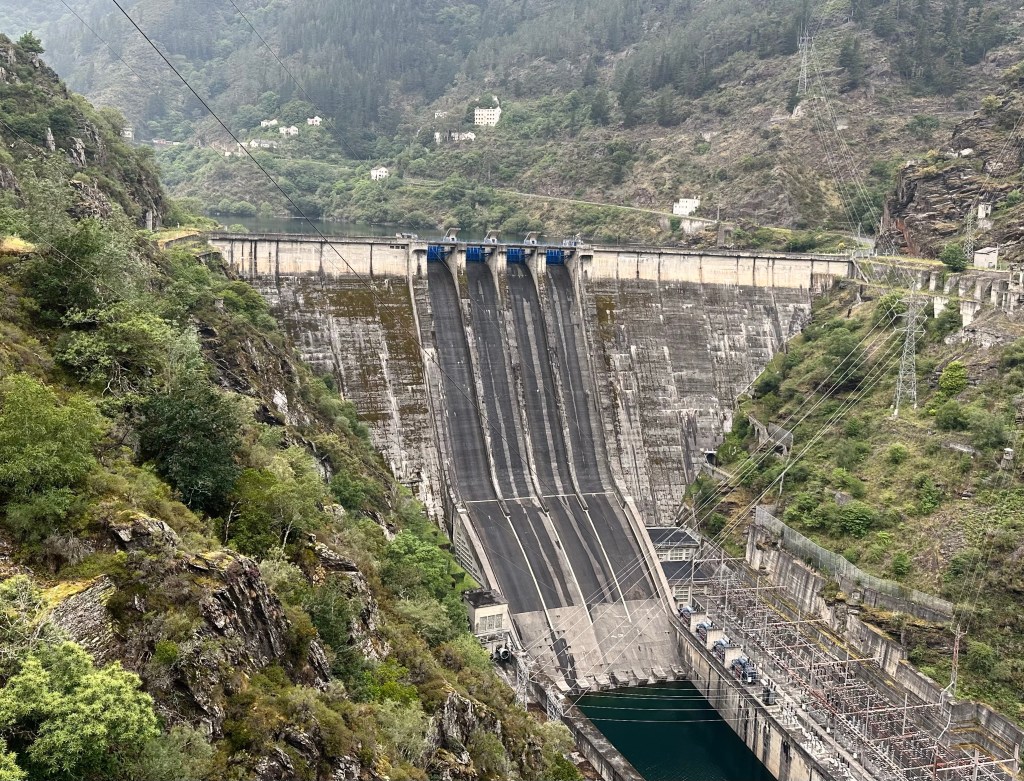
This morning started with a climb up and past the wind turbines followed by a long slow descent into the foggy forest and on to the Salime Reservoir and dam, generating 128 MW of electrical power. After crossing the dam and climbing a little ways I came to the Hotel Grandas where I was originally planning to stay, but realizing that it was such a short section, I had changed my plans to stay near the village of Castro, another 10 miles further ahead.
Salime Reservoir The height of the dam above the foundation is 132 meters: it once stood as the largest dam of Spain and second in Europe.
I had a fresh orange juice at the Hotel Grandas overlooking the reservoir, then continued along a country road and forested trails to Grandas de Salime, a busy village. I walked by the church and went in, hearing guitar music. Before I knew it, I was handed a song sheet and suddenly realized it was Sunday and mass was about to begin in a few minutes. I stayed, feeling a bit conspicuous in my Camino gear. I was in the second row back and just as the Mass started a young man came in and stood in the front row. He had some kind of nervous affliction and kept moving forward and back, or sideways, or in a bowing movement while seated. I wanted to lay my hand on his shoulder and tell him “Tranquilo, amigo,” and imagined him cured. Of course, I reasoned, I could not touch him – there was no predicting how he, or other churchgoers, might react. At some unseen signal, he went to the altar and picked up the collection basket and proceeded to collect donations. During the peace-giving, he went up and down the aisles shaking everybody’s hand. Later, he collected the song sheets. After mass, as I was walking to Castro, I struggled with the futility of faith. If the priest could transform a piece of bread to the Body of Christ, then surely he and Christ could cure this young kid of the nervous disorder. After a while, I realized that possibly by giving this simple soul a purpose, such as collecting alms or song sheets, the padre was giving him a reason to rejoice in being alive.
Later, I met the priest, a young man who would have no problem attracting women if he had chosen another profession. Actually, I had met him the night before, at Alberge Miguelin where he had dropped by after celebrating mass. I was nearly to my destination for today, Casa Rural San Julian when I stopped at La Parilla restaurant for a beer. I normally don’t have my “arrival beer” until I have actually arrived, but I saw another pilgrim couple and decided to stop. Soon after, Padre Pedro came into the same restaurant. I asked him if he would sign my “pilgrim’s credential” that I have previously mentioned. He was happy to comply: “Yo soy El Camino, Jesus of Nazareth”.
I ordered a bowl of butter beans with jabalí while I was at the restaurant and as I ate, the thunder, at first distant, moved in closer as the skies darkened. I skipped a cortado, paid up, said goodbye to padre and the pilgrims, and made off for Casa San Julian. The rain was pelting me as I arrived, but no damage done. Soon I had showered, dressed into clean dry clothes, found the bar and here I sit, watching the rain from the inside!
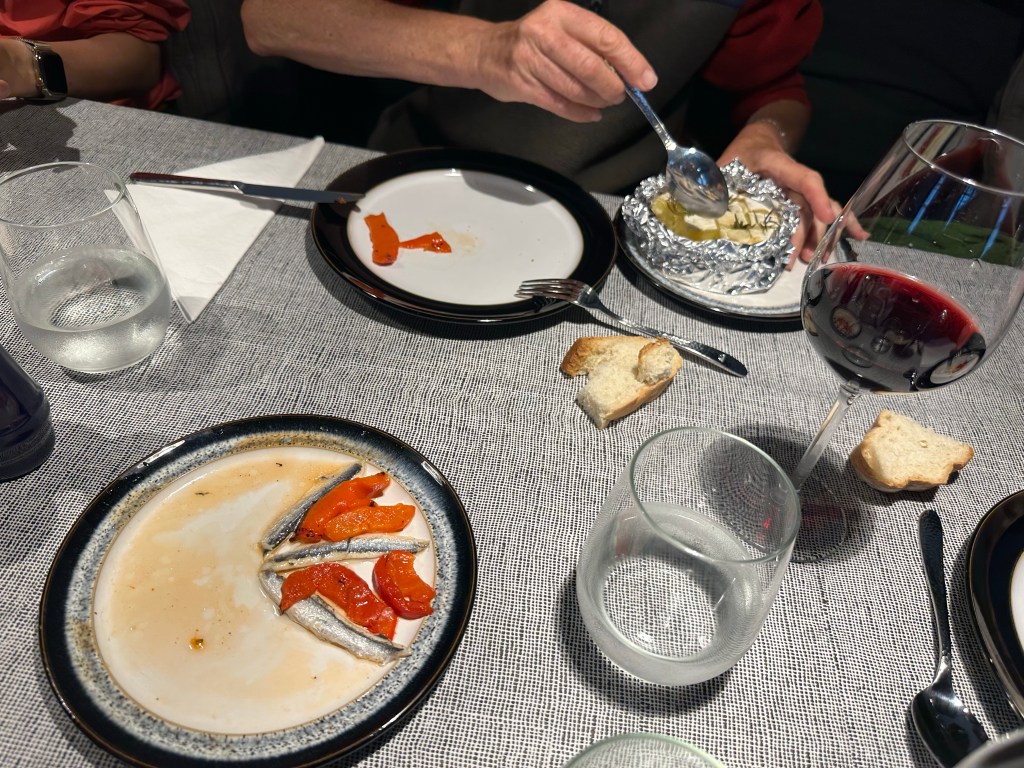
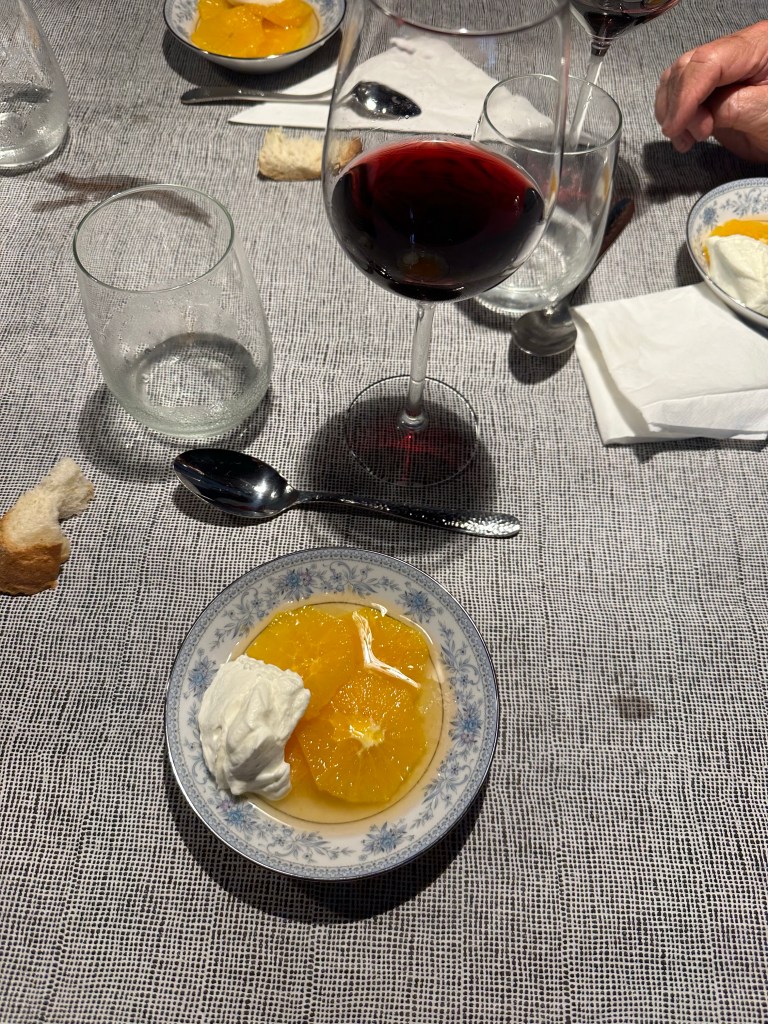
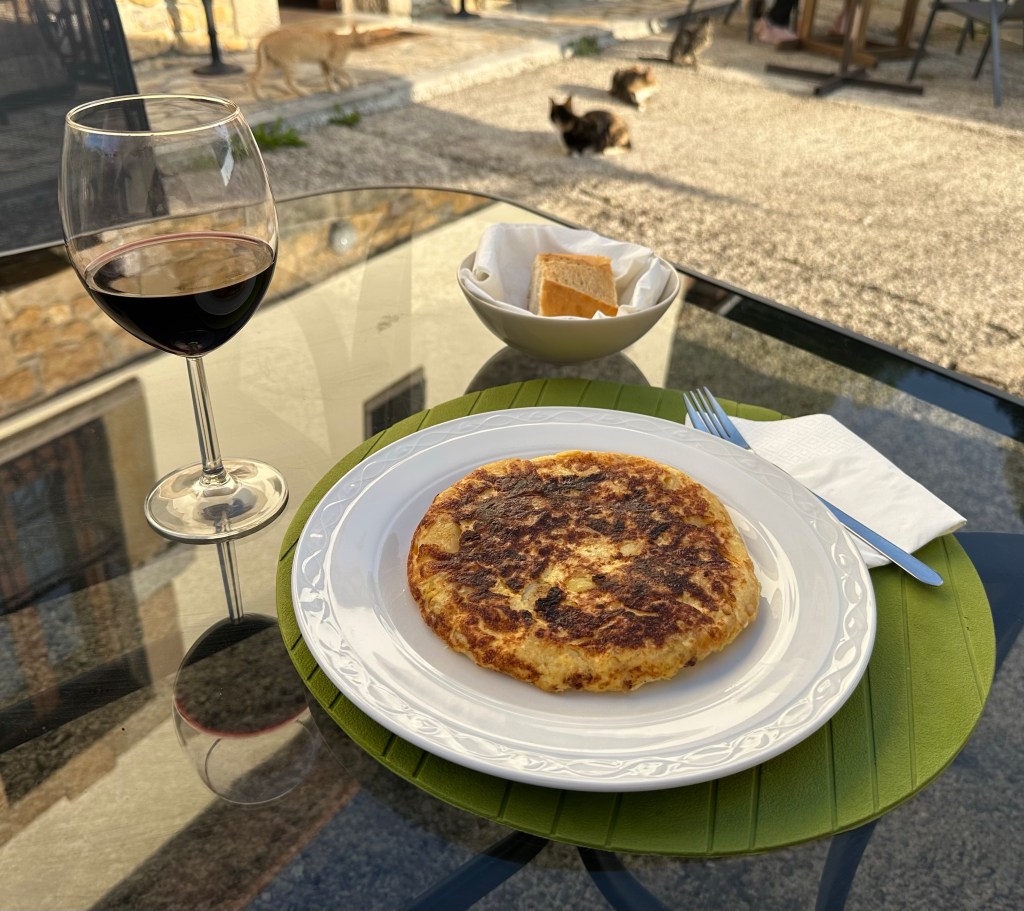
Sean and Mynhardt operate Apartamento Casa San Julian and the Polavila Restaurant in San Julian, just before you get to Castro. The rooms are clean and tidy and the dinner was the best I had on this entire journey. Interesting anecdote: Sean the Irishman and Mynhardt the South African won the Best Tapas award at the Holy Week Festival last April with their rendition of a Scotch egg!The meal started with anchovies and red peppers along with baked Camembert with rosemary. It went so fast that I nearly did not get a picture. The main was a pear tart with a pesto base topped with butter-softened leek, a padrón-pepper jam and beetroot with feta cheese and ham along with an asparagus quiche. Tomato and lamb’s lettuce (think watercress) salad on the side. Desert was orange slices soaked in a Grand Marnier and brandy sauce.
We are all always looking for that “gem”: the place that is at once so inviting you are afraid this might be the one, but you do your best to hold back your expectations because of previous disappointments. There were no disappointments here: from start to finish, it was a grand pleasure. The rooms were comfortable and rustically decorated, the bar was well stocked and had comfortable seating, the meal was a perfect blend of flavors, colors and textures, and the hosts were overly generous and polite without being obtrusive.
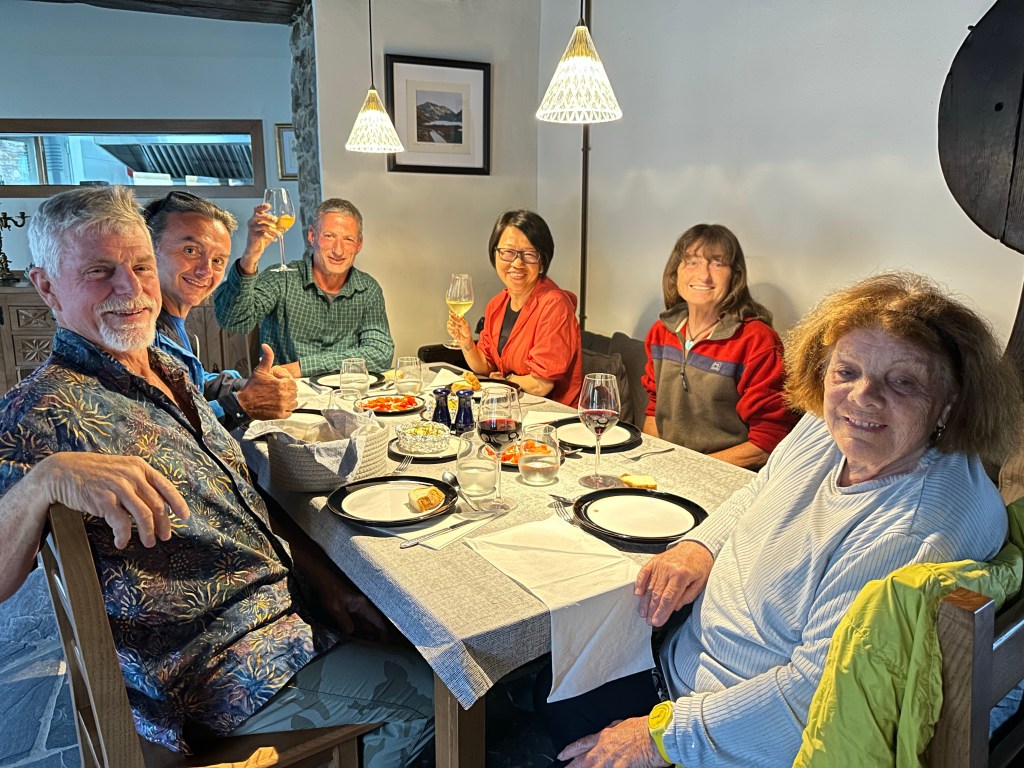
From Houston, Italy, Israel, Singapore and France x 2: Buen Provecho!
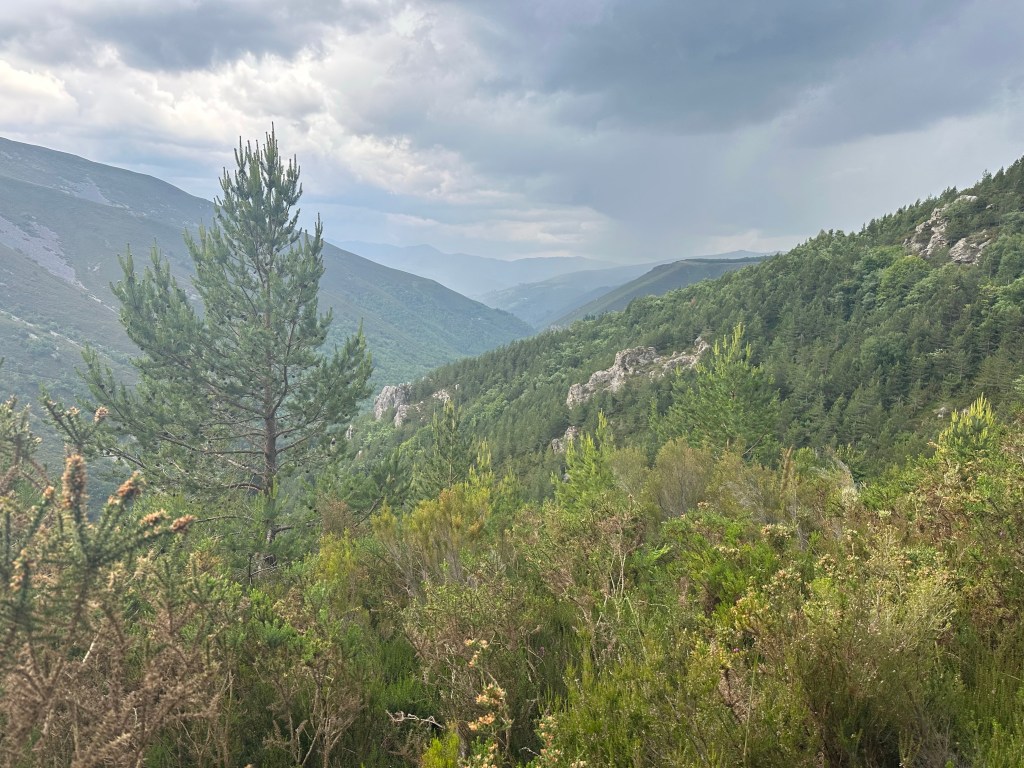
Today, I believe, was the defining stage of the Primitivo. The Camino rose from 600m to 1130m rising above the tree line to reveal some magnificent views. I took the Hospitales route which is recommended in good weather and for most of the day I had great weather. It was a magnificent day and although a bit different from what I expected, it made this whole adventure a rewarding experience.
The day started with a heavy fog which soon began to burn off.
I took a lot of pictures but it was hard to capture the colors and depth and breathtaking panoramas. As I started out, there was one pilgrim ahead of me. He had a good pace and although I approached him a few times he was soon off into his own world. He did not want to chitchat which was fine with me. I bumped into a few people going the other way.
This fellow, let’s call him John so I don’t have to butcher his name, had walked from Bilbao to Santiago and was now returning via the Primitivo towards Bilbao. I asked this fellow where he was from and he began relating the war between the dragons and the lizard people, pointing out that in the distance behind him was a portal to somewhere of importance. I asked for a quick photo before the portal closed, but unfortunately iPhones cannot capture the supernatural. We had a nice long chat. He lives in the Canary Islands with a survivor of one of the African wars. He likes to immerse himself in whatever he happens to be doing, which currently is hiking.
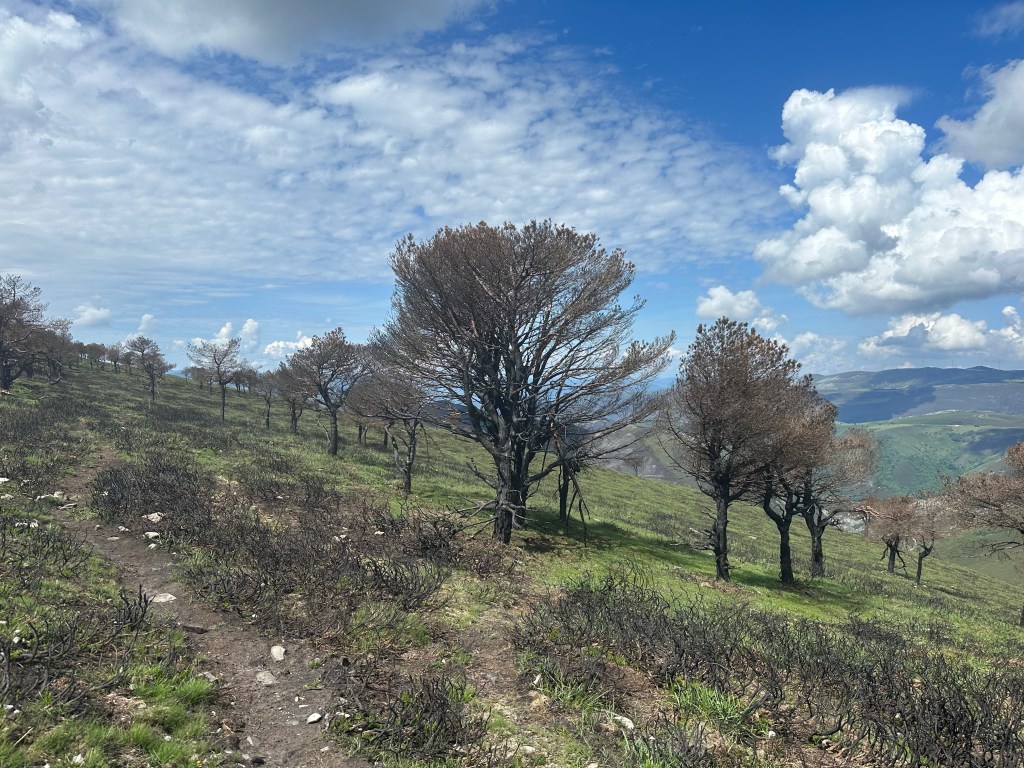
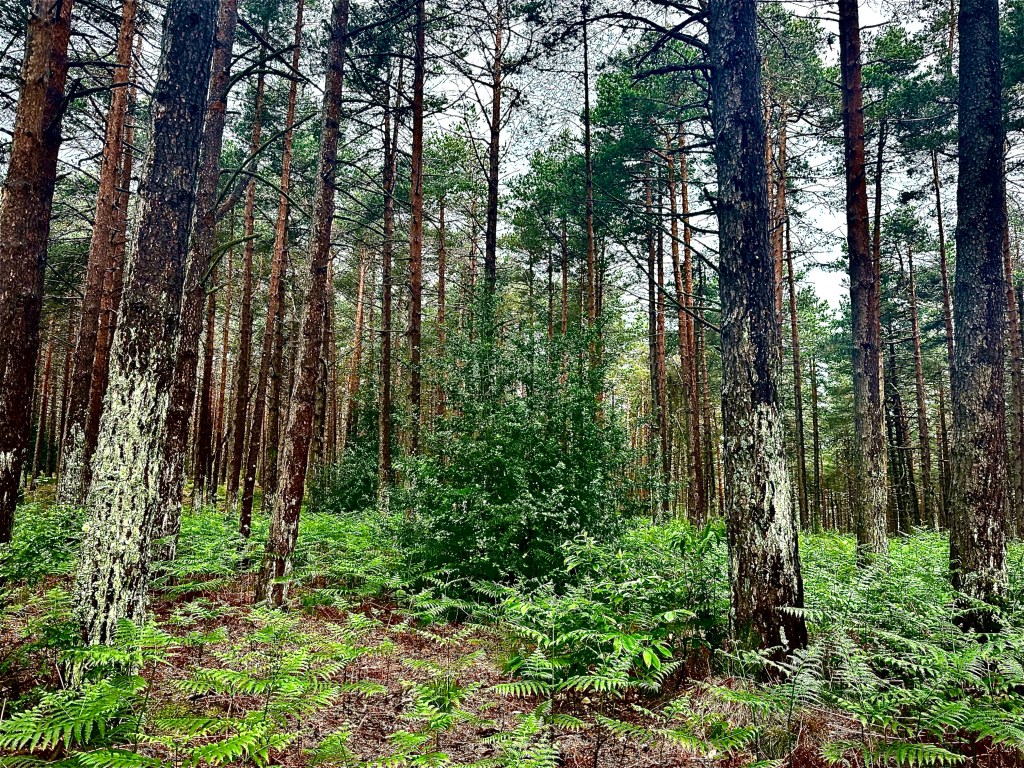
There were some forest fires last April that swept through the area I passed through today, as attested to by a lot of black trees. However, the vegetation is coming back and the locals expect the trees will too.
What goes up must come down and the trail eventually led down from 1120m to 850m. I began hearing thunder and noticed dark clouds ahead. Today the rain caught up with me and I pulled on my handy Hefty bag, and soon found a chapel with a convenient portico sheltering several pilgrims. After half an hour it cleared up and we were on our way. I going to stay in Berducedo. I thought I had a private room booked but the fellow who attended me said, no, this is an alberge. I didn’t mention that I have stayed at many alberges that also had private rooms. I asked if I could rent a towel. No, he reminded me, this is an alberge. I resigned myself to doing the communal thing, but was not happy with the guy’s surly attitude. The pins and needles sticking at odd places in his face did not help me feel welcome. Long story short, I found a room in the next village and grabbed my gear and hiked another hour and found a very pleasant place alley Alberge Miguelin where I am sitting with a glass of wine writing this post.
I must mention one other person I met. She is a French girl traveling solo (from Paris) who does not stay in alberges. She spends the night in a sleeping bag in the fields, in a tent if rain threatens. She would not let me take her picture. She wants to go to Senegal next. Draw your own conclusions.
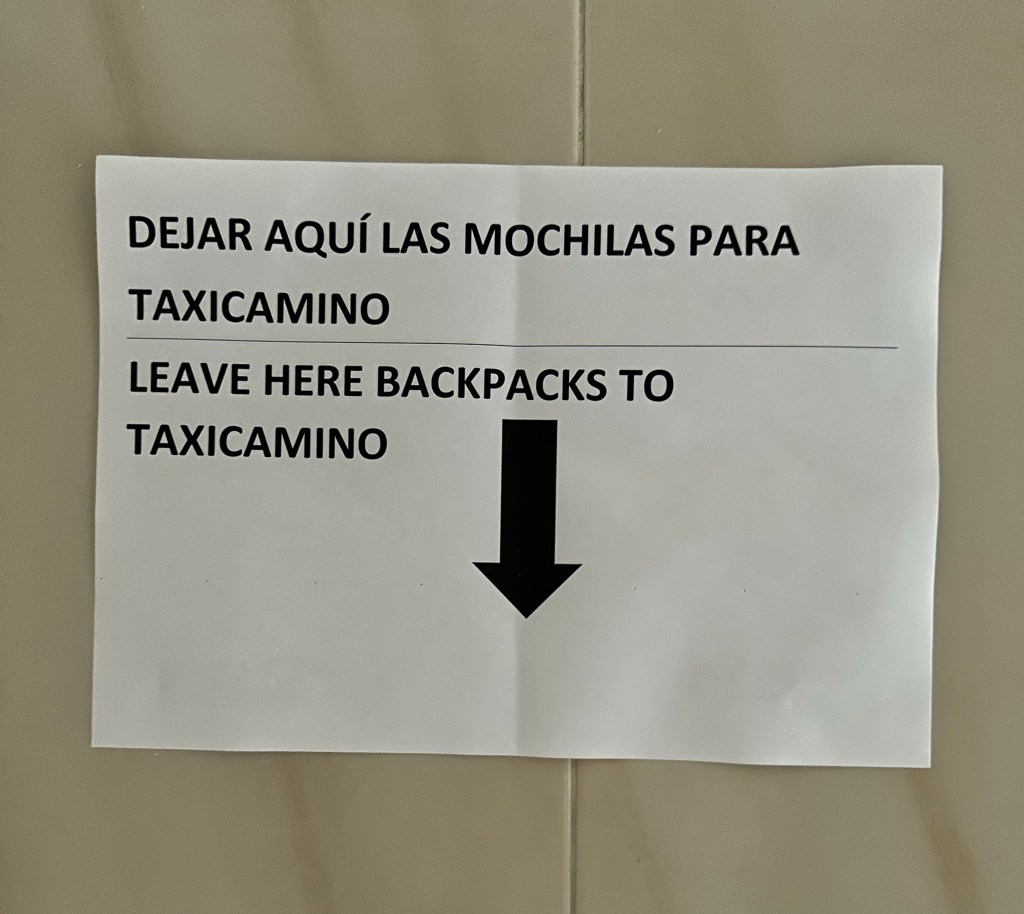
I spoke of signs in a recent post. Well here is one I saw on the wall of the alberge I stayed at yesterday.
TaxiCamino, as you might have guessed, is a baggage transport service.
Me:  Hmmm!  A transport service.
Left foot: Yay!!!
Right foot: Woo hoo!!!
Me:  Whoa!  Doesn’t mean I’m going to use it.
Left foot:  Why not?  We are tired of carrying your backpack.
Right foot:  Yeah, we wanna break.
Me:  Look here now!  A pilgrim must carry his backpack. It’s part of the deal.
Left foot: Oh really?  And where is that written down?
Me:  You wouldn’t understand. It’s like staying in the alberges with a bunch of other people. Like having shell hanging on your backpack. Like using poles, for goodness sake!
Right foot:  Well you don’t do any of that. You don’t even collect stamps!  Your just a phony-grino!
Me: I am not!  I want to to find strength in weariness and shoulder the load for all who cannot walk the Camino!
Left foot:  Oh for heaven’s sake!  Listen, you’ve got a 20 mile hike and your rucksack is full of a bunch of stuff you don’t even use!
Right foot: OK, OK, stop!  We are going to take a vote. I vote for TaxiCamino
Left foot: Me too!
Both knees: We vote for TaxiCamino, too!
Lower Back Pain: I’ll take a part of that vote.
Crick in the neck: Hey, I’m in too!  That’s 6 to your 1!
Me: OK!  I hear you!  But if they lose my backpack I am going to be really angry!
Entire Body: breaks into Alleluiah chorus.
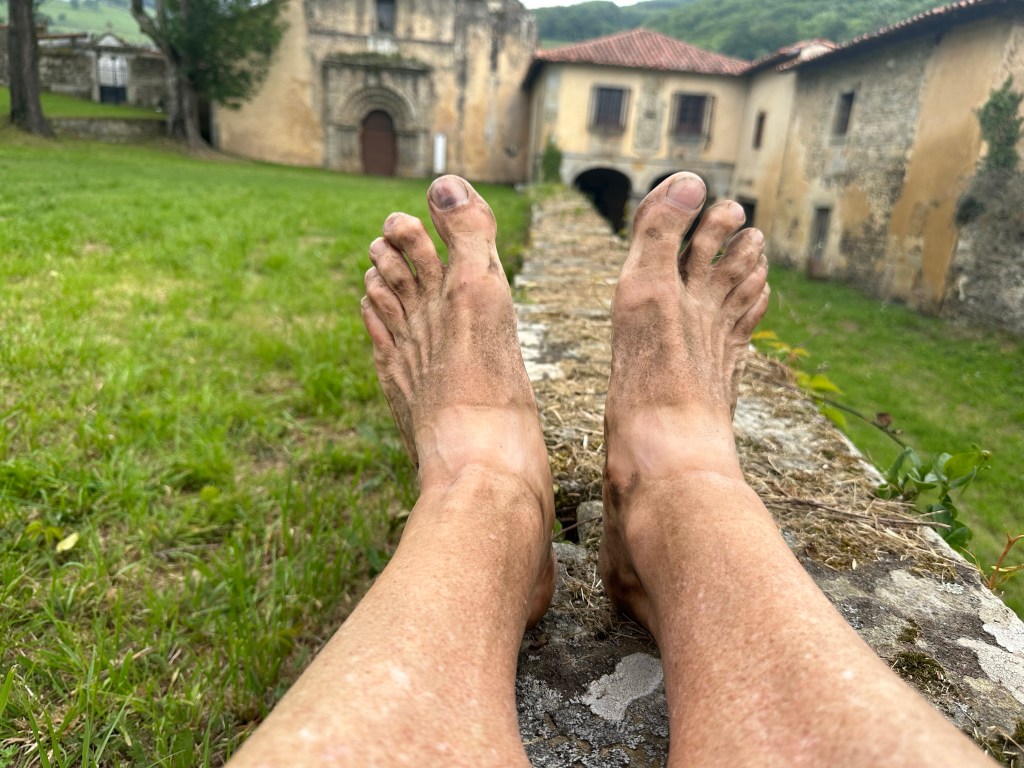
No doubt, today was a long walk. Twenty miles without a backpack but a lot of up and down. It started out great, I was cruising – my sassy feet had wings! But the last 5 kilometers felt interminable. Thunder was rumbling at my back, the wind began to blow cold, and the raindrops started pelting down about a kilometer from Casa Herminia, my stop for the night. I departed at 8 am and arrived at 5 pm. Without any breaks because if you don’t stop when you see one of the few bars along the way, you don’t eat or drink! And my feet? Funny you should ask:
As I got in the shower, I eyed the toilet brush. No, not that dirty!I met Jesmond and Mark, a father and son team from Malta. I told them I lived in Malta many years ago, when Jesmond was about ten years old. It rekindled many memories of the great drilling guys I met there. Some real real legends like Parley Poulson and Cliff Cook. They could outfight, outdrink and outdrill anyone else in the oil patch.
Salas, today’s destination, is a happy little town. It was a shorter walk than average, just under 13 miles and the Alberge Valle de Nonaya where I am staying is clean and tidy. I have my own room but I share a bathroom and kitchen area with three other rooms. I was first to arrive so I had a clean shower to myself. Then I did my laundry, consisting of my shirt and underwear along with another shirt and hung it outside the window where there was a clothesline handily installed. After completing my chores, I laid down for about 30 minutes with my feet raised on a pillow. Although short, the trail had some steep and often rocky ups and downs and my feet were complaining about the abuse I was putting them through. But I try to get a 30-minute decompression every day.
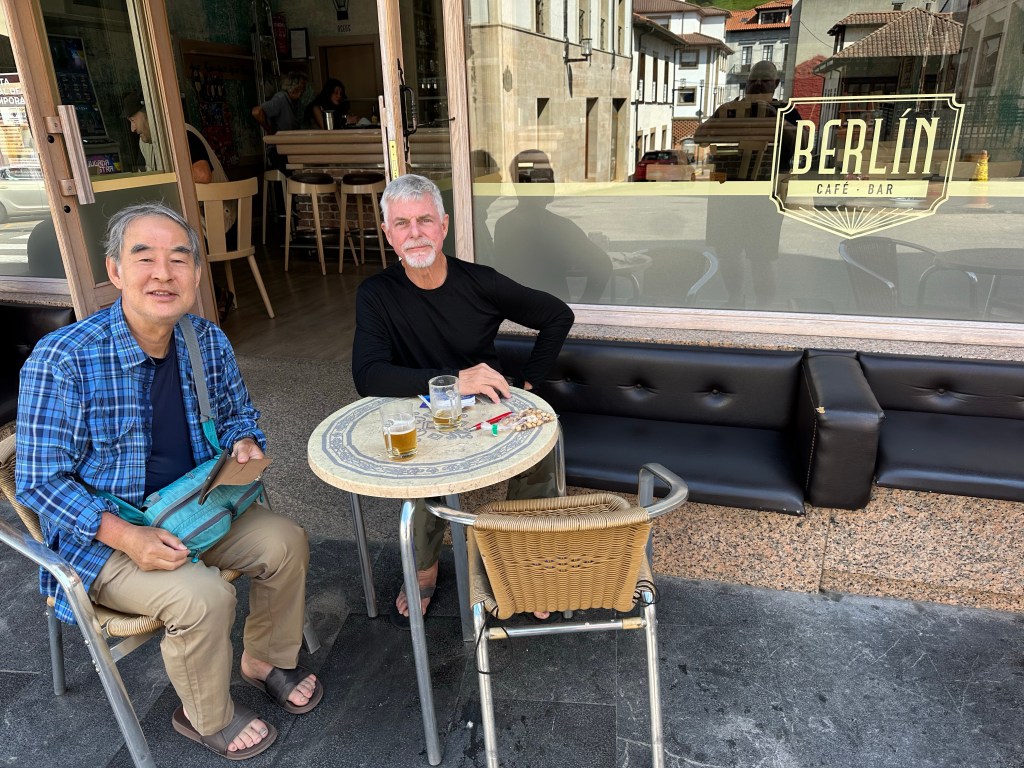
Then it was off to the bar for my arrival beer. As I was sorting through the day’s photographs, a gentleman I had seen early that morning departing Grado walked by. We greeted each other and he sat down to join me for a beer. His name is Takaya and he is a classical guitar performer and instructor but has lately taken to playing the Portuguese guitar accompanying Fado singers. In case you had forgotten, fado is a form of music popular in Portugal characterized by mournful tunes and lyrics infused with a sentiment of resignation, fate and melancholy. Fado has become very popular in Japan. Takaya told me a beautiful Portuguese Fado singer asked him to play a Portuguese guitar and he could not refuse.
Takaya has chalked up seven Caminos. He told me about the Ohendo walk around Shikoku island, over 1000 km long and visiting 88 temples. He has not attempted that one yet, because it is so close to home.
Takaya explained that Japanese has two alphabets, plus the Chinese alphabet. He wrote my name in one alphabet and it used the characters for “office work”. I told him I was retired and he wrote it in another alphabet where it means “dream time”. I told him I thought that was much more appropriate.
The Primitivo family is coming together after only two days. Many of us are on the same schedule and we crisscross each other through the day.
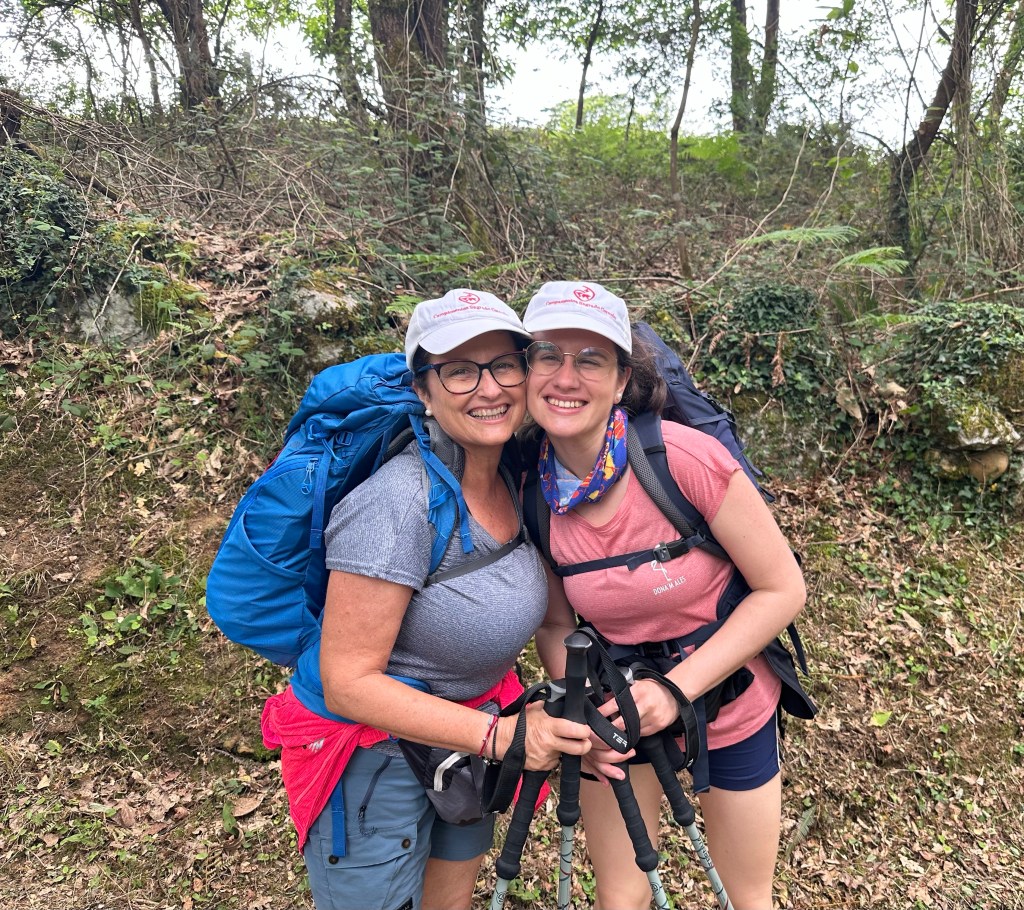
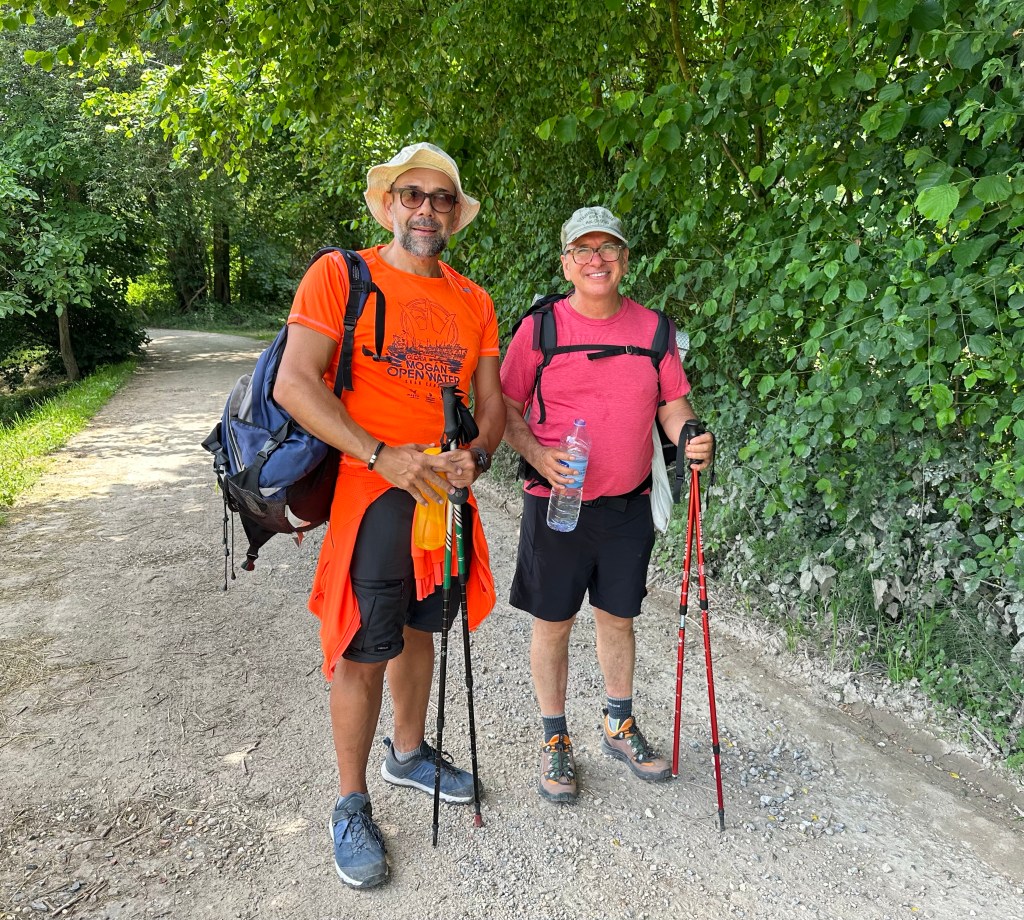
Therese and Martine are from Barcelona. This is me and Bent, from Denmark. He walked the Francés from St Jean to León, switched over to the Camino San Salvador from Leon to Oviedo and is now doing the Primitivo from Oviedo to Santiago on a 1000+ km trek. Then he might do a reverse to Porto! His Facebook page is under Bery. From Canary Islands and Mexico CityA couple ladies from France. Each one caught me peeing in the woods. Pardon! Sometimes you find a great spot to relax; sometimes the place finds you.
Are you a believer in signs? Do you think there are messages in your dreams? Do you look to the zodiac for guidance? Or is this all superstition and nonsense? Consider this: As I left my hotel in Oviedo this morning, I walked by some golden beads lying on the sidewalk. Reminded me of Mardi Gras beads so I kept walking. But the glitter stayed in my mind and I returned and picked them up. It was a rosary, and not a plastic one but some kind of solid metal. I thought, “I was meant to pick up this rosary and take it with me to Santiago.” As I walked on, though, other thoughts came to mind. This was a very nice rosary and someone was probably stressing out and praying to find it. I turned around again and went into a coffee shop across from where I found the beads and gave the rosary to the waitress. What do you make of that? At the very least, I hope, good karma!
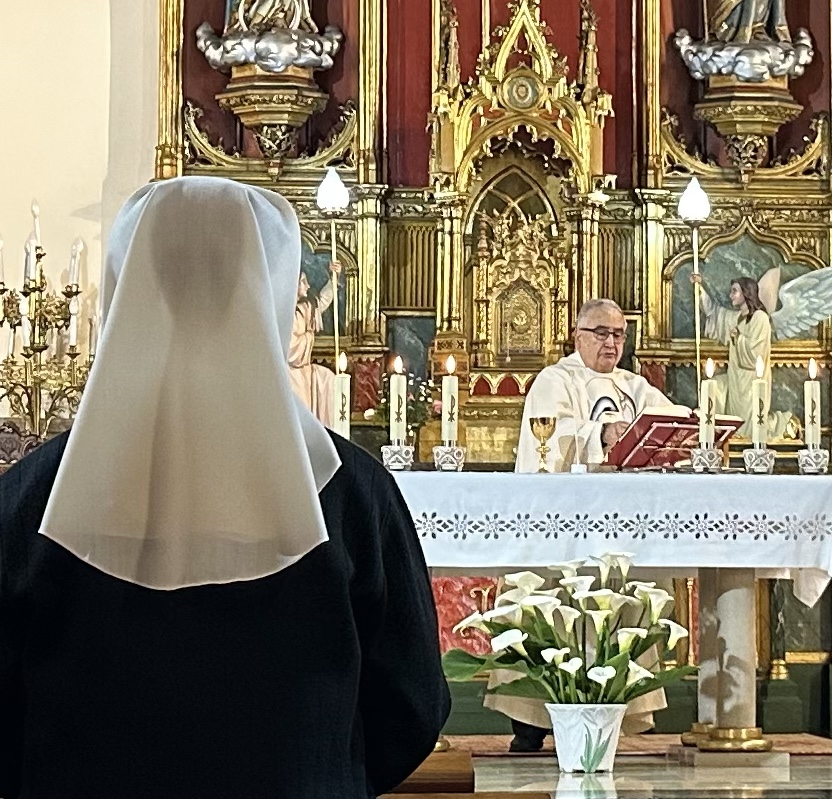
On the way out of town I noticed a chapel with door open. I walked in, hoping to sit for a few minutes of peaceful contemplation. Instead, I found that the Mass had just started. I sat there until it was over, and a little longer listening to the nuns singing songs whose melodys were vaguely familiar.
Mass in the chapel serving the Servants of Jesus of Charity order. They provide hospital and medical care in Latin America and Asia. They work among the poor providing food and health services.
The day started out chilly and foggy. By the time I was well on my way, it was warming up but the sky remained clouded over – perfect hiking weather for me. There were several coffee bars and restaurants along the way. Most of the trails were wooded, rural dirt or stone paths; a small portion was asphalt and even less on busy roads. by the time I reached the first day’s destination, Grado, it was bright, sunny and hot.
I did a little bit of this I did a lot of this
I actually went down (total descent: 620m, or 2000’) more than I went up (total ascent: 470m, or 1550’). But that will change tomorrow. The scenery is beautiful and it is so green! Lots of cattle and sheep and horses.
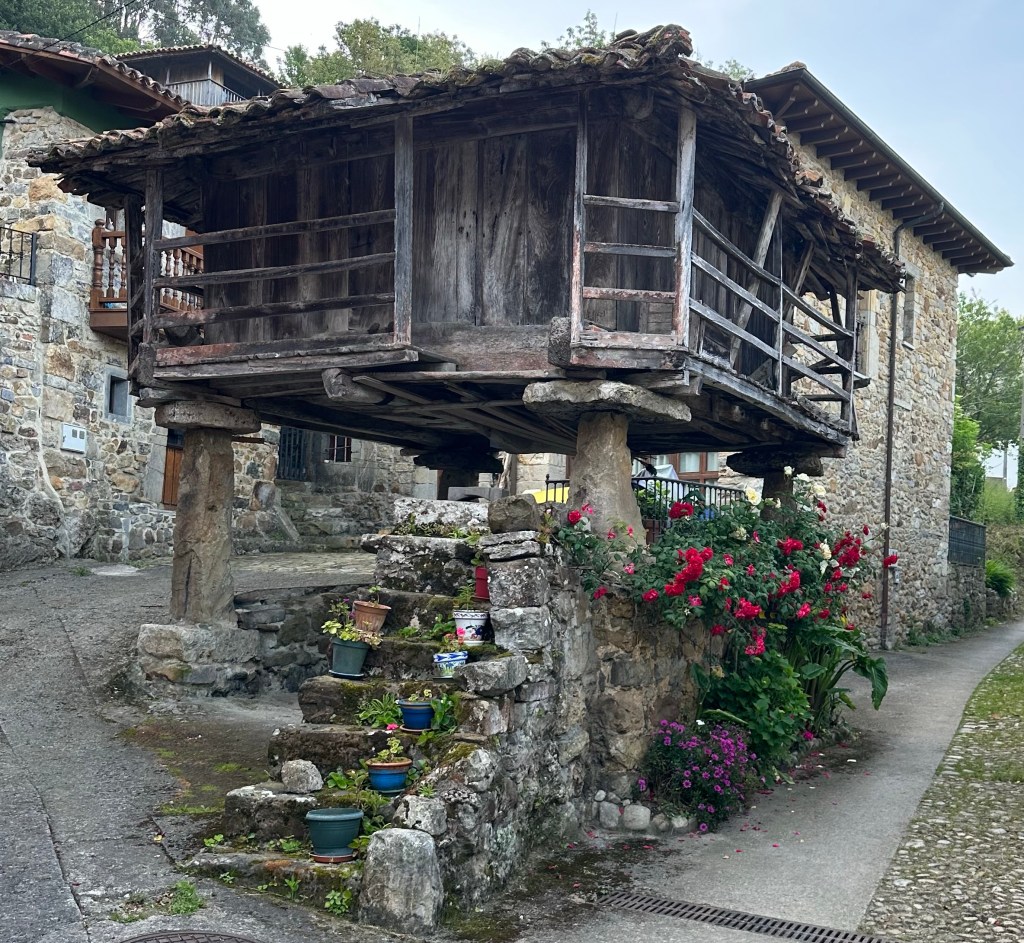
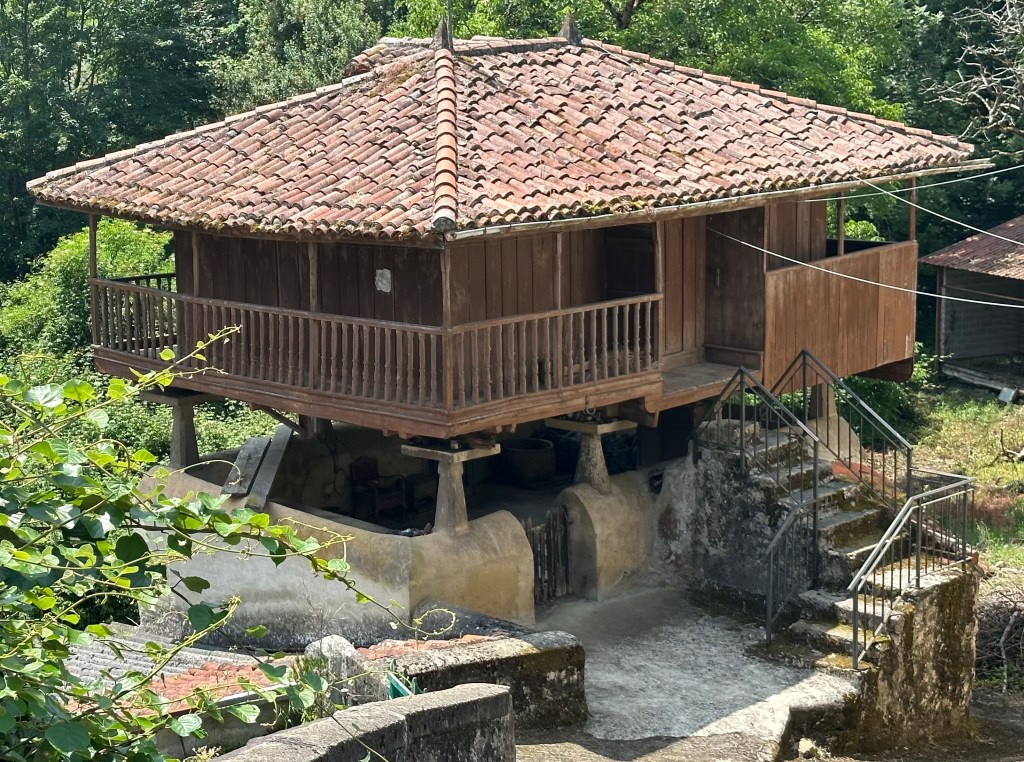
By the way, and Lisa will be interested in this, I have been seeing a lot of hórreos since entering Asturias. We saw a lot of them in Galicia last year. Most are very old structures but here in Asturias there are a lot of new ones. They were originally designed to hold grain and other crops and keep the varmints out. You can see the flat rocks on top of the legs which little critters cannot negotiate. Now, it looks like they are used for other purposes, including grandmas house.
This is an example of a very old hórreo. You can see the leg and stair design prevents rodents from accessing the storage area. This is a more modern hórreo where grandma might live. Careful of that top step, Nona!Randy, here is your horse. Now come on over!
Today I made it to Oviedo, or Uvieu in the Asturian language, the capital of the Principality of Asturias and the “official” starting point of the Camino Primitivo.
The Umayyad invasion of the Iberian peninsula began in 711 and by the end of the decade, they controlled most of the peninsula. Pelagius (Pelayo) was a Hispano-Visigothic nobleman who established the Kingdom of Austrias in 718 and is credited with initiating the Reconquista when he attacked and defeated an Arab-Berber army at the Battle of Covadonga. He is thus considered the forefather of all future Iberian monarchies, including those of Castile, Leon and Portugal. The culmination of the Reconquista would not come until the united kingdoms of Isabelle I of Castile and Ferdinand II of Aragon defeated the last moorish stronghold, the Nasrid in Granada in 1492.
The Camino Primitivo is said to be the first pilgrimage to Santiago. The Spanish King Alfonso II walked from the Asturian Kingdom’s then capital, Oviedo, in the 9th century after hearing that the remains of St James the Apostle had been discovered in Compostela. There is also a Marian pilgrimage between Oviedo and Covadonga (GR-105, in case you are interested).
I was planning to take a break in Oviedo, rest my feet, perhaps mail some of the extra cargo I am carrying ahead, make some advance lodging reservations and generally prepare for the subidas and bajadas that are coming up. But why waste time? So I embark tomorrow in the footsteps of Alfonso.
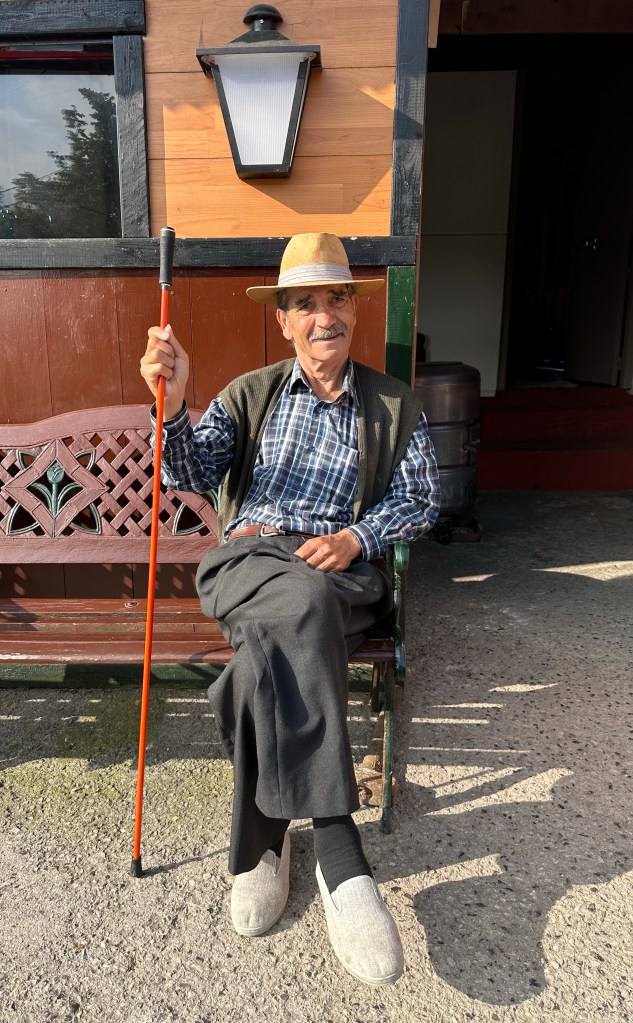
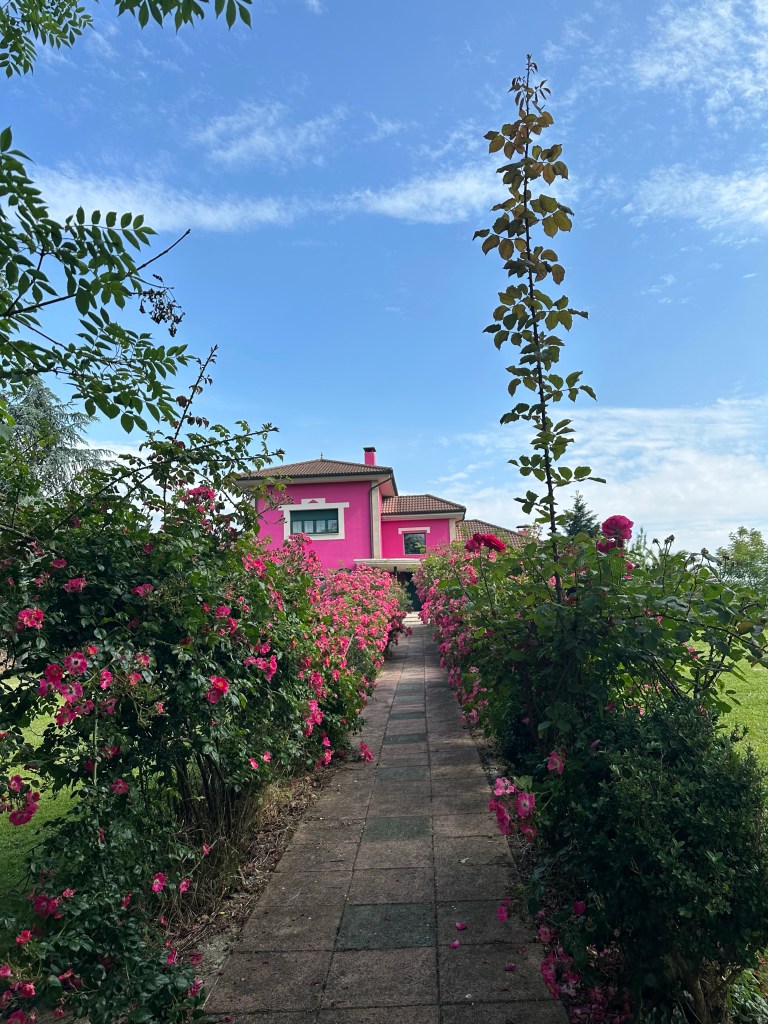
This is Harry. I met him on my way to Oviedo. St. Peter’s church, near Colloto. Closed. I was also hoping to see the insides of the Oviedo Cathedral. Also closed on feast days. Today is Martes del Campo, something like a San Isidro holiday. I have been in Asturias about a week and I hadn’t had any cider, which is famous in these parts. I ducked into a small bar and had a shot. Then I noticed there was a restaurant attached. I ordered braised ox-tail served on arepas. The tails are braised slowly in a concoction of carrots, garlic, red wine, etc. then the meat is picked off the bone. It was delicious. Hidden behind the bottle of cider is my glass of Lopez de Haro, a great Rioja crianza. Not sure who lives here but I think I know their favorite color.
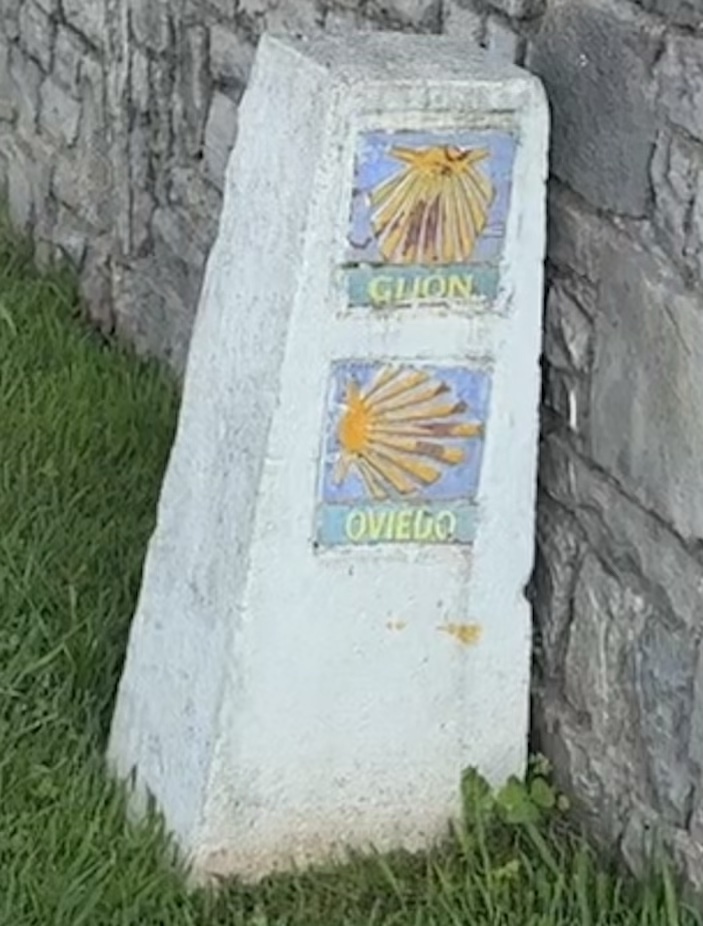
I slept good last night and took my time setting off on the trail. Just outside of Villaviciosa, the Camino bifurcates, with the North fork heading to Gijon, the other to Oviedo and the Primitivo.
Time to decide which way to go!
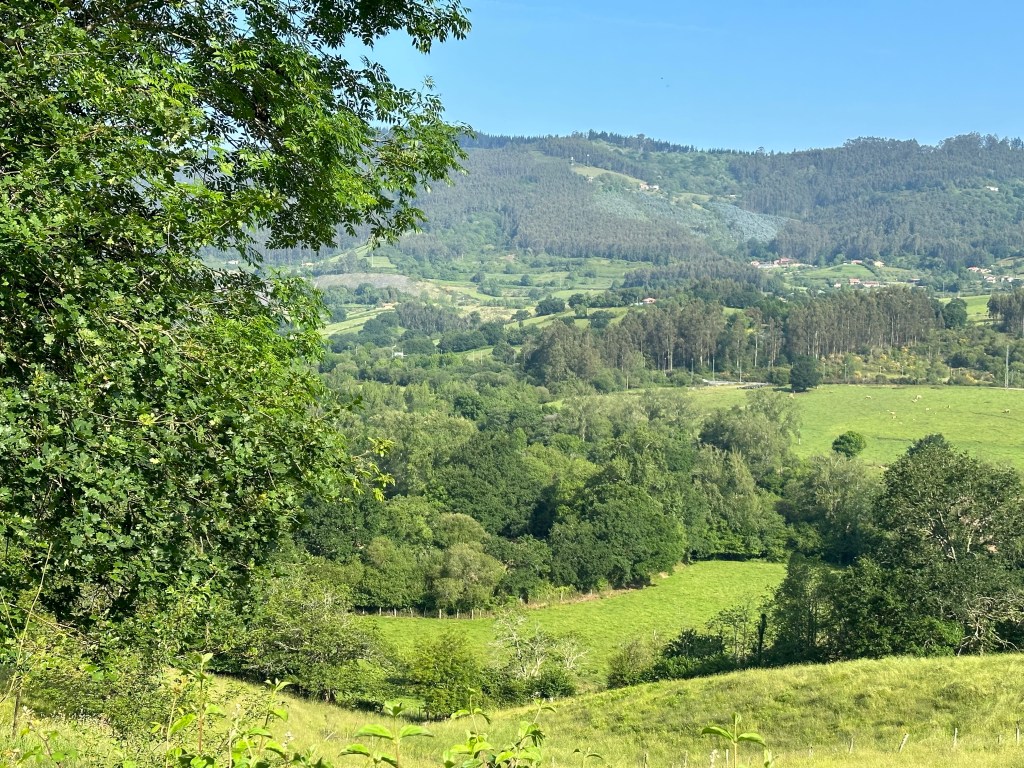
Early during the planning for this trip I read about the monastery of San Salvador de Valdedios about 5 miles outside of the village of vice and today I looked forward to visiting it. I hiked through some beautiful countryside. Who would not want to live in the Valley of God, I thought.
The hillsides above the Rio Valdedios. Final approach to the monastery of San Salvador that I had been looking forward to visiting.
When I arrived, I noticed the gates were closed. I walked up to a notice board with the schedule. Should open between 10:30 am and 1:30 pm. I read further. Cerrado Lunes. I must admit I was upset, as though it has been closed intentionally so I could not see it. In a bit of a funk, I left and began a nearly 500 meter climb. By the time I reached the top, I had forgotten about the monastery! Not too long after, I stopped by a coffee bar and found Oliver from Germany. He had been 60/40 on doing the Primitivo. “I am 100% now!” he told me. Mimi and Martine from France were lunching at the same spot. They had also attempted to visit the monastery. “Don’t schedule anything for Monday in Spain!” advised Martine.
Oliver is a strong walker and ready to take on the Primitivo.
I relaxed for a while after Oliver and the two ladies set off. I thought about the monastery and realized that missing the visit there was really of no consequence. Instead, I had a good training session for the climbs to come. Then I, too, set off. It had been very hot before the lunch stop, but now a mountain-born breeze swept the valleys. Still, I began to feel tired, but kept pushing myself along country roads. It was as though the previous day’s marathon had taken a lot out of me.
With about an hour left to go before reaching my casa rural for the night, I was walking along a wooded path and a bench appeared. My tired body was drawn to it and I was unstrapping my backpack as I neared it. I plopped down and heaved a sigh of exhaustion. Without looking around, my eyes focused on a tree directly across from me. I stared at the tree for a long time.
I like trees. I sometimes wonder if they are conscious or not. Certainly not in the way humans are, but they did evolve from some primordial life form, just as we did. Is consciousness a fundamental property of living things or an emergent phenomenon experienced only by Sapiens?
My tiredness disappeared. I took a long draught of water, made myself comfortable on the bench and removed my glasses. Apart from that morning at the beach, I had not stopped long enough to relax and meditate. And now I did. This was something I had planned to do as well. The gates to meditation were not locked. They were wide open and they swallowed me up.
My dinner at El Calero, nestled in the countryside. A fitting stop before the big city of Oviedo tomorrow.
Last night I was faced with a major decision. The coastal trek with its ups and downs, and trying to keep pace with Steve from Montana and Collette from New Zealand, had left me too tired to consider the options: a short walk to Colunga or a much longer trek to Villaviciosa. So I decided to sleep on it. I awoke and showered and packed my bags, still not deciding, but in a positive mood. I went down to the lobby hoping I could get a cup of coffee. “Are you 307?” asked the night manager. “Oh, my room number! Yes, I am 307.” “Well, I have laid out breakfast for you.” And so he had: there were honeydews and croissants and boiled eggs and cheeses and more. And a coffee machine that produced a very good cafe con leche, which, when augmented with a cortado, made the perfect eye opener for me. Having supped on olives the night before, I ate a bigger breakfast than usual.
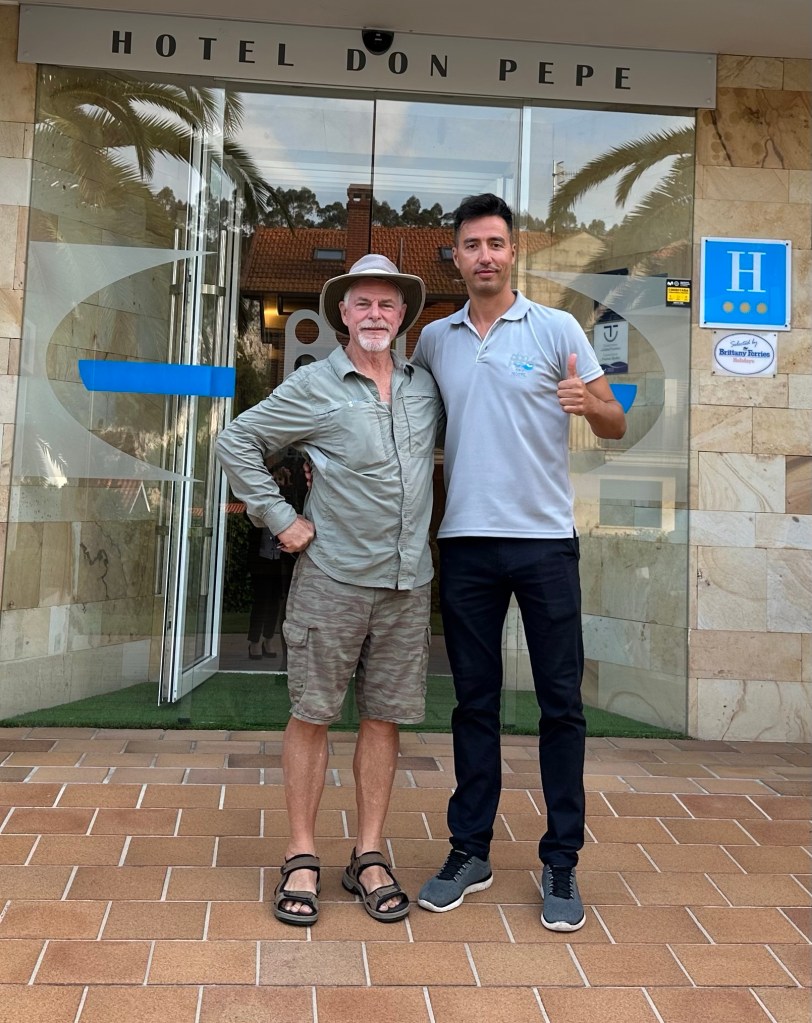
Most pilgrims collect “sellos”, or stamps, along the Camino. Instead, I am collecting “dichos”, or sayings from different people along the Camino. When I asked Adrian, the night manager, to write something for me, he was pleased to comply. Adrian told me that life can be compared to an hourglass. We live on the top of all the sand that has seeped through the neck of the timepiece, representing the past. Our present life is the falling sand. We cannot see from where we are how much sand is left on top, or our future. It may be a few grains or a beach full. He took my “pilgrim’s passport” and drew an hourglass with the inscription: “We do not know what lies ahead; enjoy every day.” He was nearly forty years old (he looked about thirty!) and had been working in the hotel business since he was eighteen, doing everything except making the beds. He had recently bought a van to travel around in, which was his dream. Adrian is a madrileño, but when I assumed that made him a “gato”, he corrected me: gatos are the offspring of parents who are both madrileños and his mother and father were not born in Madrid.
Me and Adrian at the Don Pepe hotel.
Adrián had treated me so well that I had nearly made my mind up to do the long walk to Villaviciosa. But I wasn’t quite there yet. I left the hotel, walked down to the seaside promenade and headed west. An older gentleman came walking the other way and wished me “Buen Camino!” I acknowledged with a nod, but as I walked past I called out to him. I thanked him for being the first person to give that greeting this morning. We chatted. His voice grew serious and he told me he had a gift for me. He opened his palm and gave me a memento which meant so much to me that I could not quite fathom it. I told him it must be very special to him. After all, he carried it in his hand as he walked. “A gift, if it is to have any meaning, must be difficult to part with,” he said. “And bring pleasure to both the giver and the receiver.” We chatted a bit more, then, with a fumbling of goodbyes, we parted ways. I knew then that I was going to Villaviciosa.
Pepe and me at the beach in Ribadesella. NOTE TO ADRIAN: If you ever see Pepe walking down the boardwalk, give him an abrazo for me and tell him his gift carried me to Villaviciosa and may well yet help me fly over the Camino Primitivo.
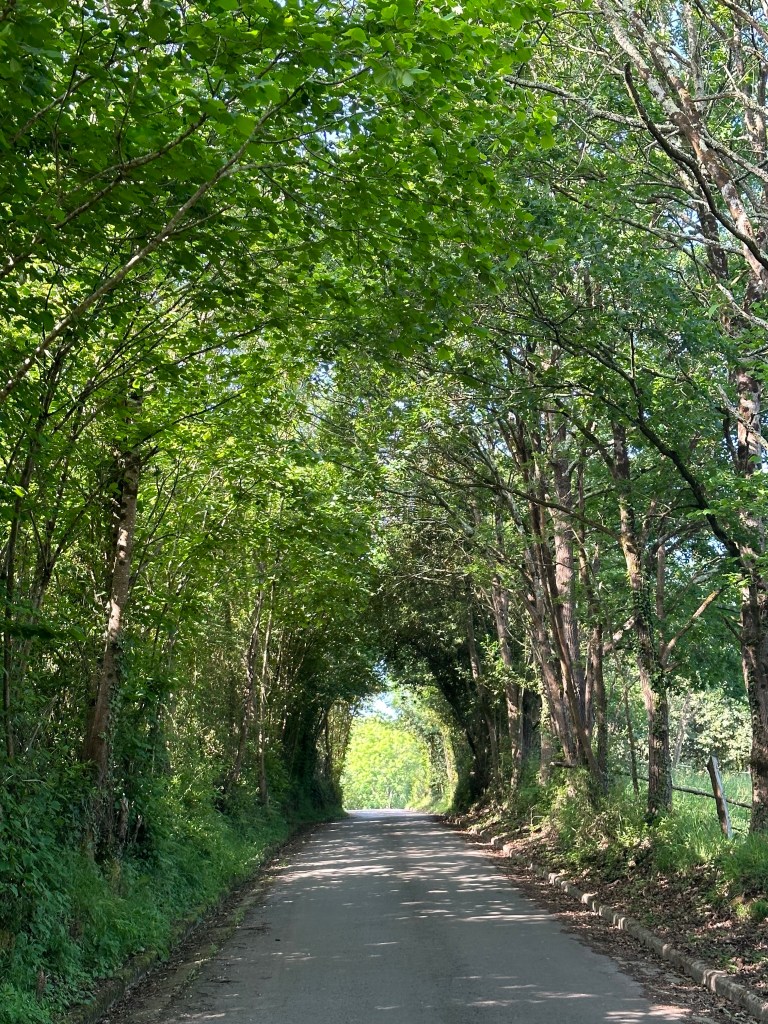
Today I did not stray from the yellow brick road. The trail to Colunga teased with a few more approaches near the coast, but afterwards the Camino led inland and the scenery changed. The countryside got hillier and the paths often led through forested green canopies.
Scott and Katita: Here is our first herd of Asturianas, heading to Texas!
Today I stay on the official Way,
And yes, TS, it’s many steps before I rest.
Time to walk, save the talk
for another day.
It might seem it’s a dream
but it’s time to pray
So I sing, the words ring,
And drift away
And so I stay on the official Way
And yes, confess, it’s time to rest.
And here I sit in the Trébede bar in Villaviciosa writing my post, with 25 miles logged, further than I have ever walked in one day! And why not come here? The name itself is intriguing, meaning “vicious village”, or perhaps, more aptly, “vice-ridden town”, but an old name, because there is not much sign of of sin in this town. Little kids run around, grandparents show off the grandkids, couples, old and young, hold hands, glancing at each other with what can only be described as love. And somewhere in Ribadesella, an old gentleman named Jose Luis, known to his friends as Pepe, sits, without a treasure he once held close, I suppose, for many years. I imagine him thinking of a stranger he met, and feeling comforted, knowing his gift is in good and appreciative hands.