Today was a very utilitarian day. I walked from Portomarin to Palas de Rei. I had a coffee here and a coffee there, none too good, but each good enough to take the time to drink. Arriving in Palas de Rei, I did my laundry. I met up with Lisa and we had a meal at Arenas.
And then an interesting thing happened. We had a discussion about what we had learned on this journey. We talked for an hour or so, with one revelation leading to another. Being a discussion between pilgrims, I cannot take it much further in this forum.
I saw someone wearing a mask today and it reminded me that I wanted to mention the issue of health, other than sore muscles or blisters. On the first day, a medevac chopper rescued a person, but there is not much information about the victim other than he or she was on another trail. There have been a few cases of Covid along the Camino. I know few of the details but I have heard of three cases. A few people I know of have caught colds or suffered allergies. There was one death of a pilgrim, apparent heart attack that I think I mentioned (Lisa witnessed the Guardia Civil managing the case). But most of us have survived and, God willing, will march into Santiago in a couple days.
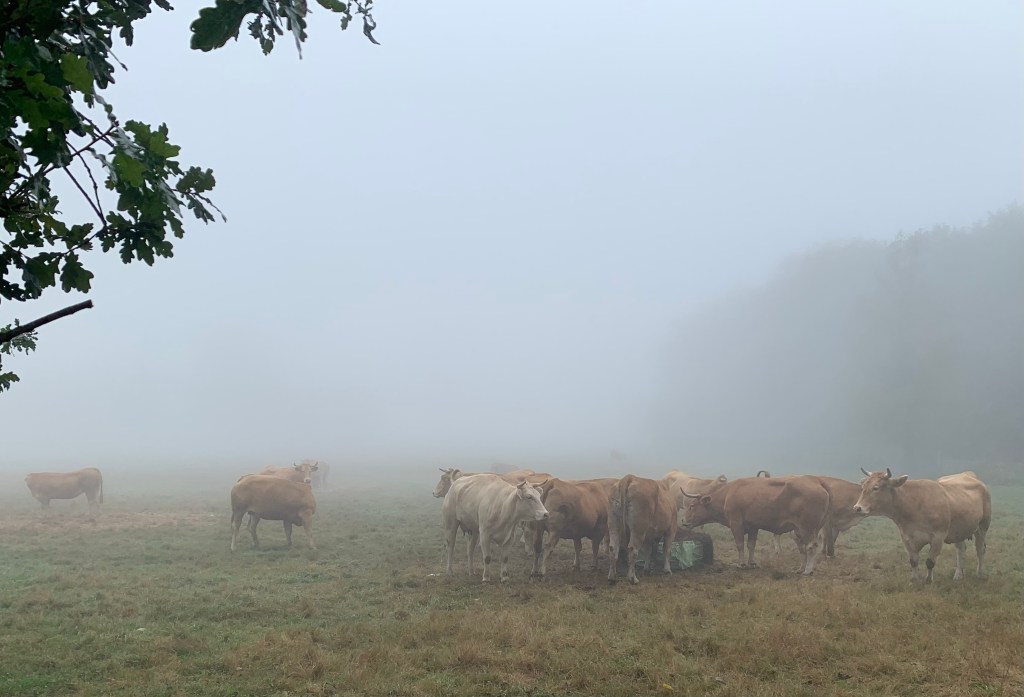
I walked past the Iglesia Santa Marina as it’s bells rang out 8:00 am. Today was a very foggy and misty day, as it was meant to be. The fog did not lift until I passed the 100 kilometer marker.
You know that today was going to be different. Let me list a few things I noticed for the first time on the Camino: much bigger groups, but admittedly not as many people as I thought, including school kids and bus tours; the bars had souvenir shops attached, with plenty of shoppers; people asking for money; actual taxi cabs parked at crossroads instead of a sticker with taxi phone numbers; and what I would call sticker frenzy.
But it was still a wonderful day. I stopped for my breakfast and chatted with another pilgrim from Korea who had started a few days after me. We commented on the “newbies”, and noted they were not much different than ourselves in the early days. Another long-time peregrino from Andalucía called these new folks the turigrinos or casacompostelanos. This was number 7 for him, so he has earned the right to call the rest of us whatever he wants. He is a man of a thousand stories. He told me that no one understands how unburdened he feels when he hoists his backpack on.
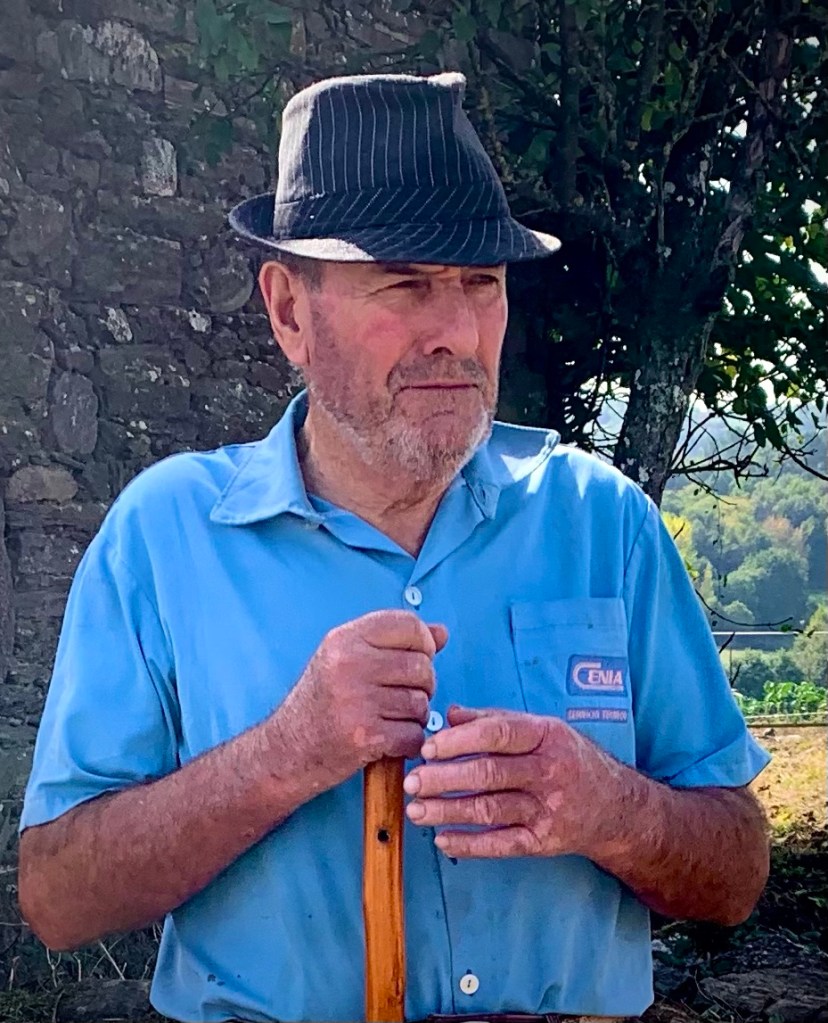
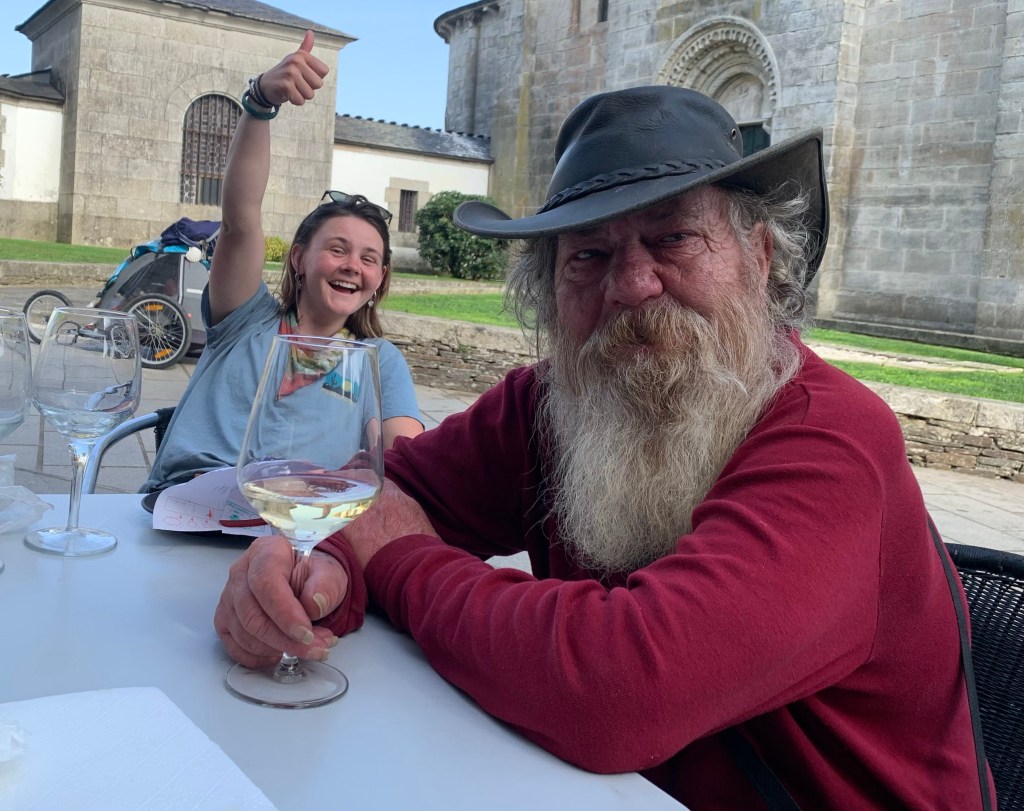
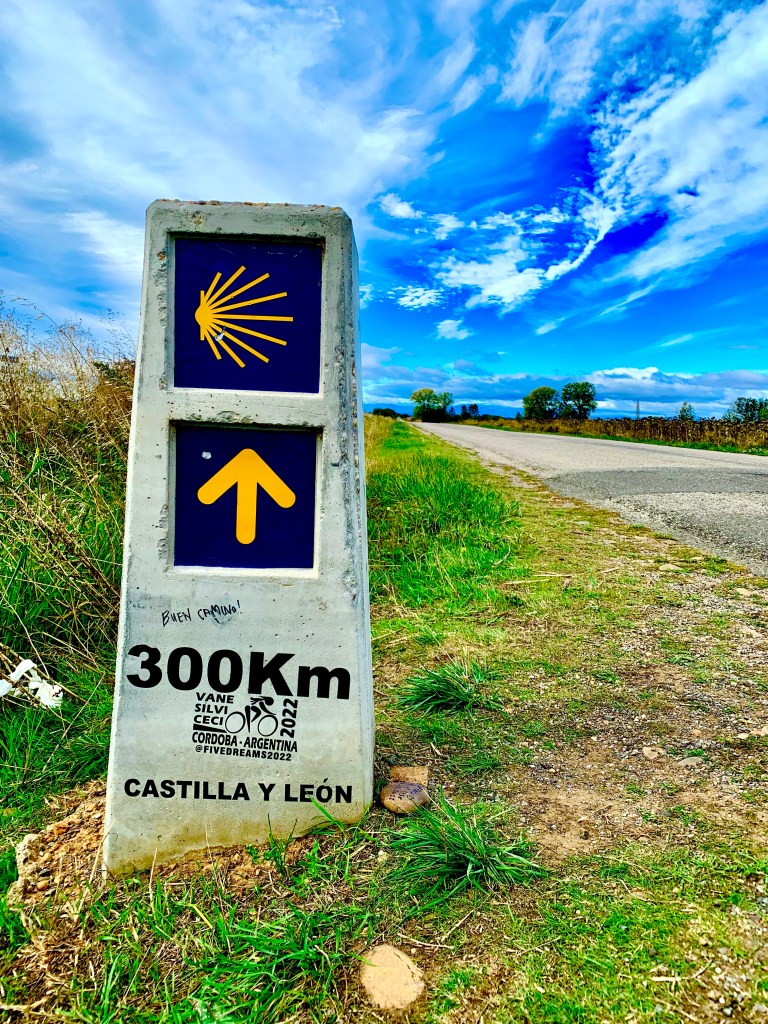
The fog did not lift until I reached the Camino marker indicating I had 100.000 km to go. This Gallego has seen many a pilgrim go by. Probably wonders what the fuss is all about. The old and the new. Antonio has been from Lisboa to Fatima to Lourdes to Rome and is now making his was to Santiago. His cart can be seen behind Maggie. Maggie started with Lisa and me in St Jean. She puts strands of tinsel in people’s hair. Her goal is to adorn 100 heads by the time she reaches Santiago. Mine was number 77.
By the way, I have selected my Camino anthem. It would not have been appropriate until after Sarria. I have not really listened to any music while walking. It seemed like such a distraction. But today I played my anthem and it actually brought a tear of joy to my eye!
I did not fall asleep easily last night. An unusual feeling numbed me and I could not understand what was it’s cause. Confused thoughts rambled through my mind. Had I come this far only to somehow not finish the walk? Was I in some limbo from which there was no escape? Would I never wake up if I did manage to fall asleep? Had I eaten something at dinner to befuddle my brain?
Tonight I understand what troubled me. Last night was my last night on a Camino that I had become familiar with. Today I walked into Sarria and my world has changed, as though suddenly the sky turned green and changed the color of everything.
In Sarria begins the final 100 kilometer March to Santiago. Many pilgrims start their journey in Sarria and complete their Camino in 5 or 6 days. New and strange faces have appeared. Conversations are different. I went to the pilgrim’s mass and the priest did not show up. Strange turns of events! The sky is green.
Sarria marks the start of my journey back to the “real world”. My life as a pilgrim, as short and sweet as it was, will soon be over. The pilgrim does not want to return to that world he has escaped, but has no choice. It is like birth. But it is also a rebirth: an awakening from an odyssey of self-examination with the realization that every tiny learning was a gift. And so, the trek from here onwards is just as important as any other stage of the Camino.
Let me mention the Camino family. From the first day, you begin meeting people. All kinds of people: single, pairs, flocks, young, old, men, women, people who talk too much, people who teach you, people who make you laugh and on and on. Some of these people you see over and over, in the towns, in the hostels, mostly walking the trail. Others have a quick pace and disappear into the distance; some are slower and you wonder what became of them; some drop out for various reasons. But as you reach the end, you have an idea of who your Camino family is. Some may be a day or two ahead or behind in reaching Santiago, but you have come to know them. Yet as close as your friendship may have developed, you realize that at the end, all go different ways to different lives. Yet we share a common bond.
And now I begin to yearn for my own family. The family that cheered me on in this quixotic quest. Paula leaves the States for Madrid today and I cannot wait to be with her. There is so much more to share with her, slowly, over time. And with JP and Jen, Jack and Michael. And the whole gang!
And Paula and I will be creating new shared experiences as we travel Spain with Lisa and John and visit with Paula and Juan Miguel in Madrid. But now it is time for this pilgrim to go to bed. I don’t think I will have any trouble sleeping tonight.
EPILOG from previous post: Tizona
I found it difficult to lay down Tizona. I imagined she would come in handy if I met up with a mad innkeeper. Or his daughter! However, I realized Tizona has accomplished her purpose with me and must be returned to the Camino. Somewhere between Herrerias and La Faba, Tizona rests with a couple of rocks forming an arrowhead, faithfully pointing pilgrim’s in the direction of Santiago.
I did not set the alarm last night and I woke at 6:30. I rolled over and slept for another hour. The previous day had taken its toll, but now I was ready to set off again.
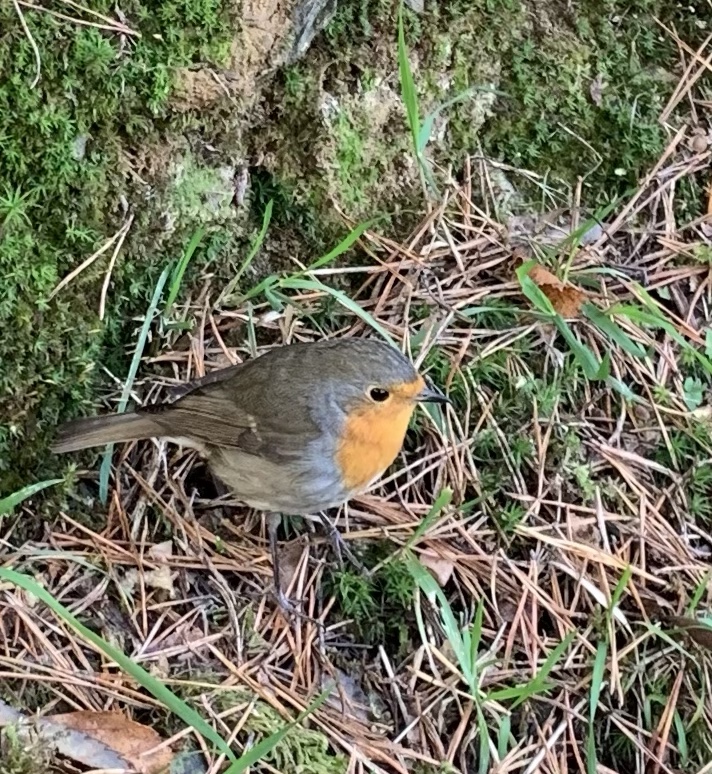
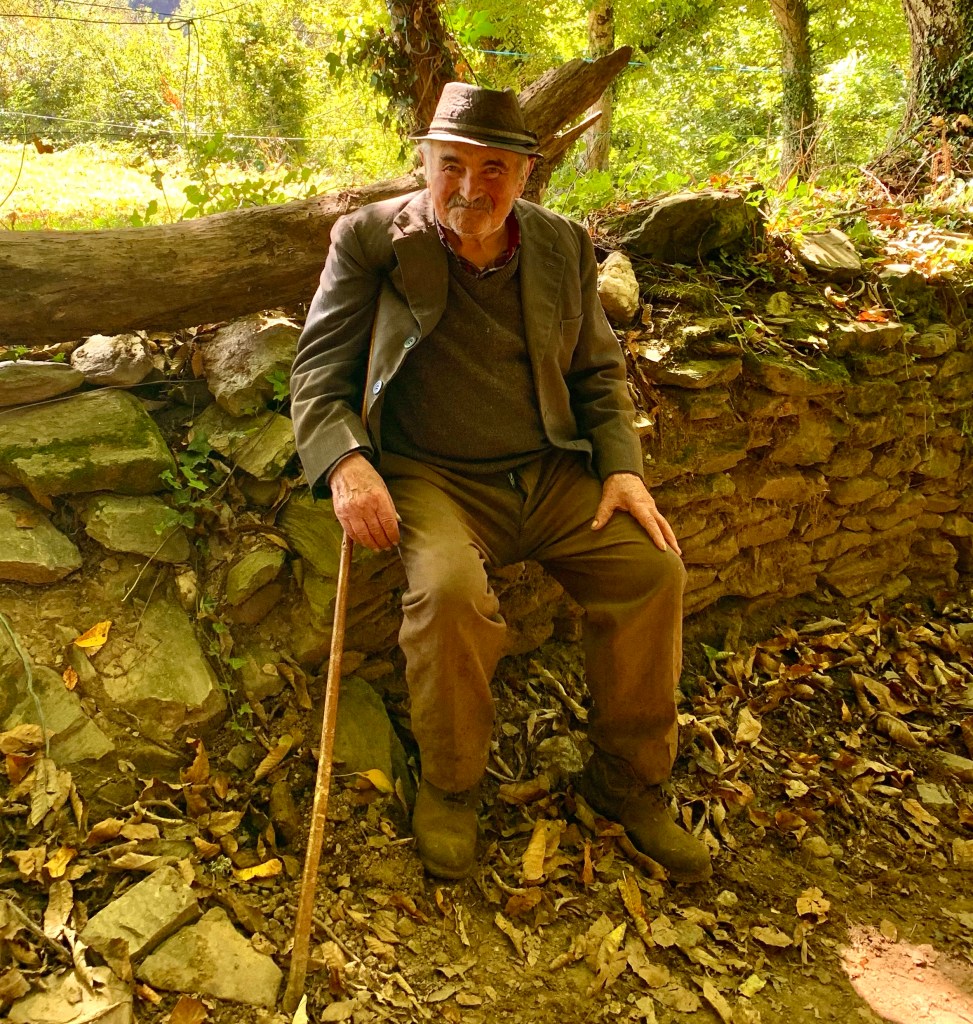
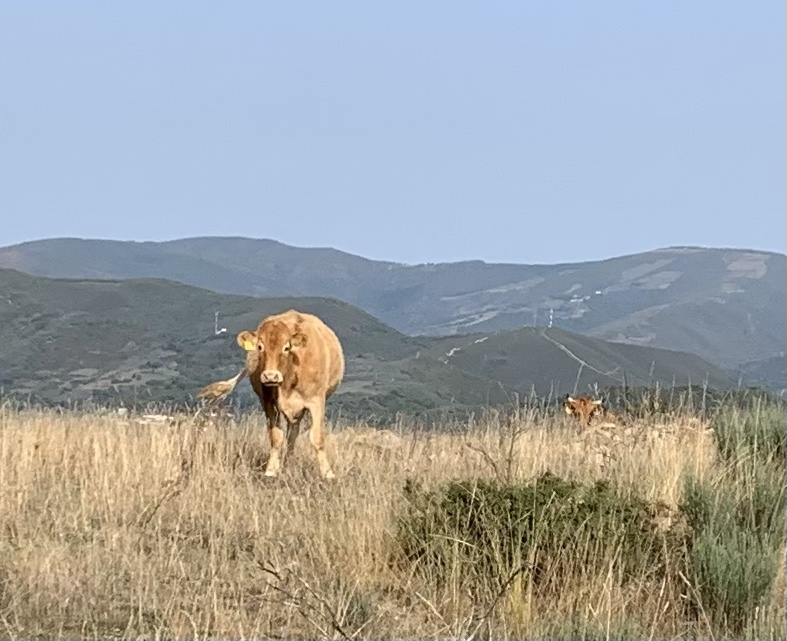
Last night, the innkeeper, Isidro, told me I should stay for breakfast, so I broke with my routine and had a coffee and homemade cake before setting off. I realized that the innkeepers and barkeeps along the road are an integral part of the Camino. Most of them are truly friendly and do their best to make your journey special. That is the way Isidro is. He takes care of every pilgrim that comes his way, whether they are staying the night or just having a drink or bite to eat. Shortly after leaving Laguna del Castillo (and I never did see a laguna or a castillo) I left Leon and entered Galicia. This was to be one of the best days I have had on the CaminoAs I entered Galicia, the Celtic spirits within my soul began to pulse and flutter. Strange but friendly sounds emerged from the woods. This little red-breasted bird hopped alongside of me, welcoming me to its home. I was filled with a sense of home-coming. I am normally an overly-rational person, but this inner sense of belonging seemed very natural. It has been with me all day and persists this evening. I took more photos today than any other day but they do not capture the color and depth of being here. I edited this picture to try to recreate what I saw. The panoramas were breathtaking at every turn, but impossible to capture.Maybe a video will convey it better. And this is cow country, by the way. An amazing old chestnut tree.An amazing old man. Who can say we are not related in time and space and spirit?
There are three routes out of Villafranca del Bierzo. There is the main route, along the main highway, although from all accounts it is quiet, and it is the shortest. The second route goes to the right and offers a bit a scenery as it runs along the hills to the north. The third route is called the Dragonte and ascends and descends three steep mountains before ending up at Herrerias, 26 km (16m) away. It includes 1500 meters (nearly 5000’) of ascent and almost as much descent. I read that the trails were poorly marked, there were no services along the way and that less than 1% of pilgrims take the Ruta Dragonte. I was in!
The day before, as I was approaching Villafranca del Bierzo, I noticed a wooden hilt protruding from the ground. As I extricated it from the earth, drawing it out like Excalibur, I realized the Camino was offering me a gift. It fit my hand perfectly and was the perfect length for a staff. I did not realize why I needed this pole, but trusting in the Camino, I accepted it, knocked off the thorns with a rock, gave it the name Tizona and took it with me. The next morning, as I left Las Doñas, it leapt into my hand to make sure it was not left behind.
I left Villafranca early and the sun was coming up as I passed Dragonte, about 6 kilometers out of town. It was on a hardtop road, but not a single car went by me. I looked into the darkness and imagined the “little people” who lived there and took note of other dark forms to ensure they were not menacing or following me. I felt secure with Tizona at my side. A couple kilometers past Dragonte and I left the road for a dirt path but now the sun was shining bright and the temperature rising. I reached the top of the first peak about 4 km past Dragonte. I had by now seen one or two vehicles, but no people. I did see a couple cows who seemed to be surprised at encountering a pilgrim.
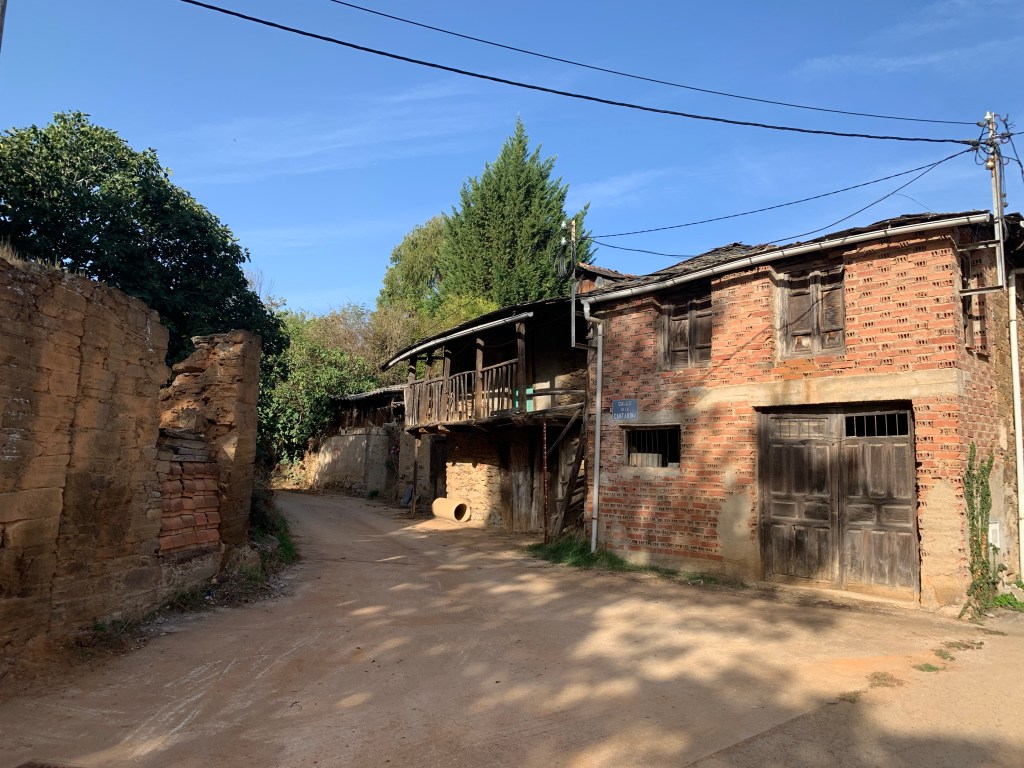
I made my descent to the next village of Moral de Valcárce (named after the valley). These were not really villages but collections of houses owned by farmers, or in such disrepair they were uninhabited. As I entered Moral, a couple of large dogs protested. I don’t mind when a dog barks or growls, but when they start baring their teeth, I get a bit worried. I thrusted at them with Tizona, not in an aggressive way but making them think twice before they made a killer lunge at my leg. They circled around behind me as a third dog appeared blocking my way. A voice shouted from somewhere and the dogs backed off a bit, long enough for me to make my escape. However, watching from a safe distance, was a smaller dog, and as I walked by him he decided to be my companion. I could not lose him. Presently a farmer in a tractor came along – my first human encounter. “There is a dog following you!” he said. “I know, I can’t get rid of him!”. We devised a plan. I struck the ground in front of the pup, breaking Tizona in half. That was not part of the plan, but I improvised and threw the broken-off limb at the dog. The farmer took over, herding the pup home. “Venga! Venga!” críed the farmer.
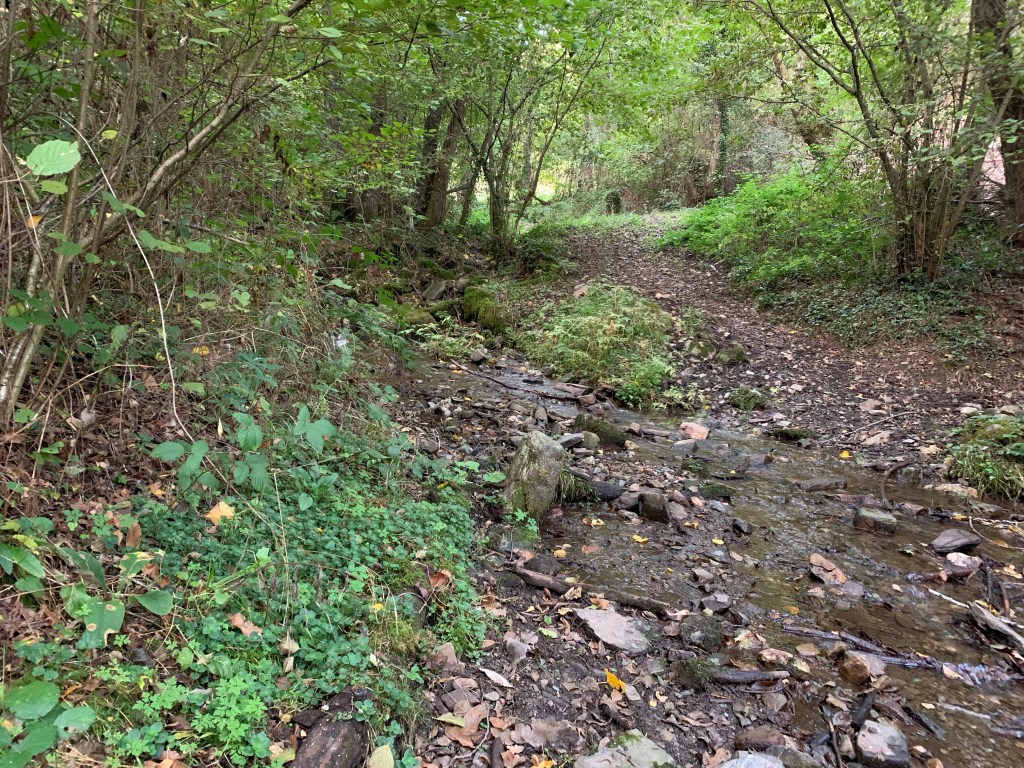
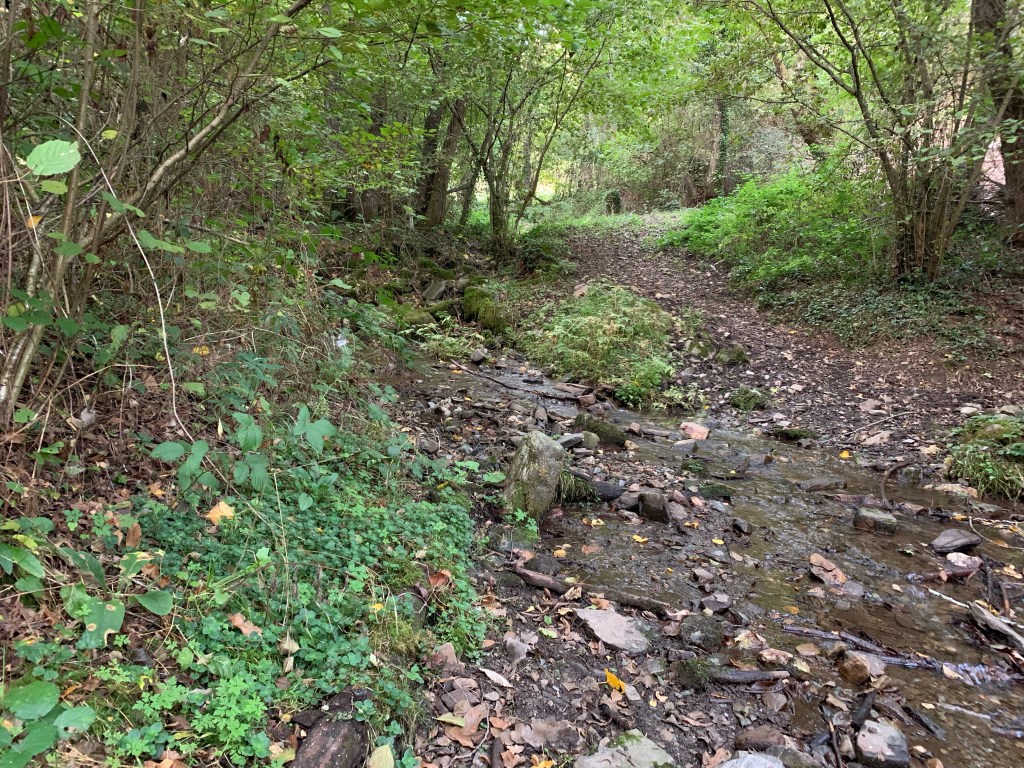
I descended to the valley, very much exhibiting its Middle Earth heritage. Sometimes streams would cross the path. Sometimes the stream was the path. Sometimes there was no path.
I found my way out of Mirkwood with its weird trees, some with ancient misshapen trunks burnt by long ago fires or hollowed out by some disease, but still supporting huge leafy branches. There were lots of chestnut trees, their spiny fruits looking like yellow-green rambutans. And on I went, making my way up to the second peak, and back down into the next valley.
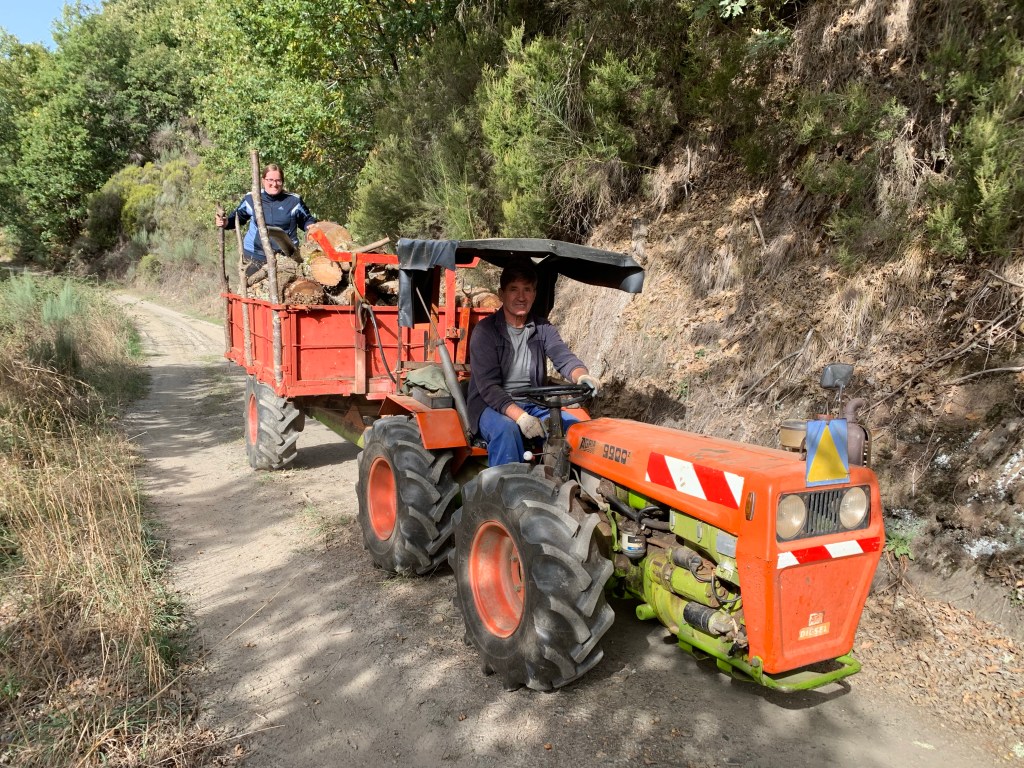
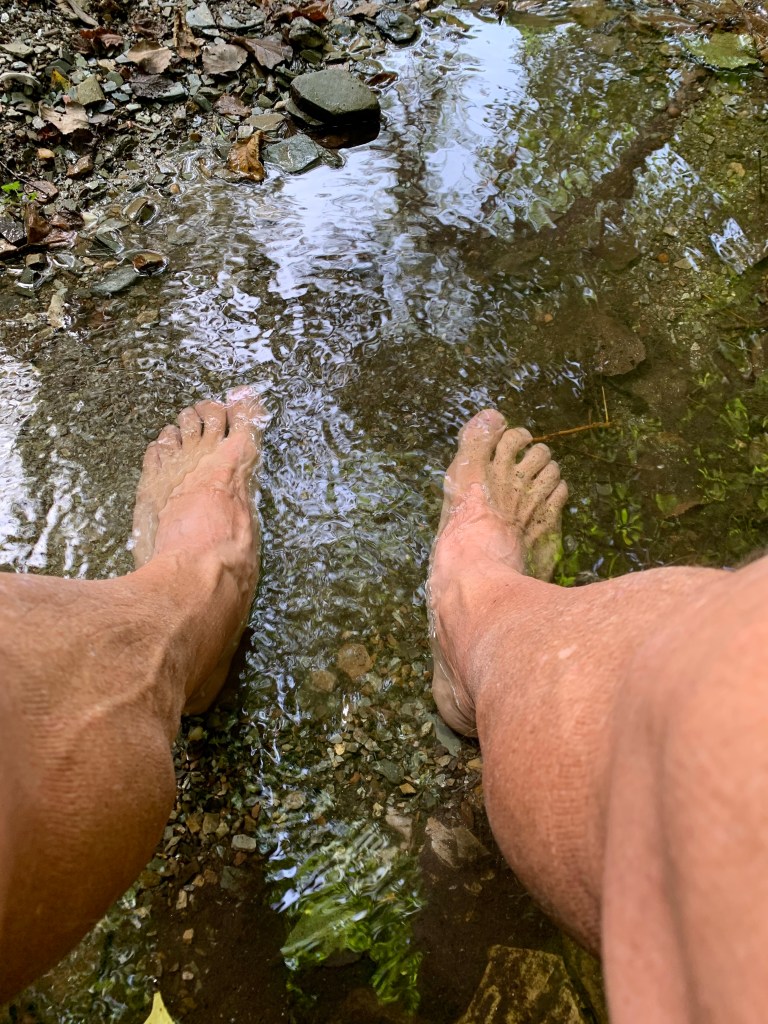
I passed this happy couple who stopped their tractor to shake my hand and wish me “Buen Camino”.After 5 hours without a break, or even a cup of coffee, I stopped by a small stream crossing the path, took my shoes off and cooled my feet. It was hard to get up and go. …et suseia!
I arrived in Herrería about 2:30 and still had 3.5 miles to go. I reached my destination, Albergue La Escuela. just after 4 pm. My longest day on the Camino, but it was ever so satisfying, and came at a good time, before the final run into Santiago. The views and experiences along the Ruta Dragonte were unforgettable. The last section to my alberge complemented the Ruta Dragonte: steep ascent in mostly tree lined path, but a smoother trail, thankfully.
First of all, welcome to Mark and Nina Menghini who are well into the start of the Camino. Ultreia!
I am having my breakfast in the town of Cacabelos, having gotten through Ponferrada and back into the countryside. I am in Bierzo region and Cacabelos reflects a good local economy: nice homes, prosperous shops, busy streets and nice coffee shops, like the one I am in. Usually, pilgrims will stop at the first coffee bar they come across when entering a village, as I did coming into Cacabelos. But one look at the wilted croissant, and I moved on – and found the place I am sitting in, filled mostly with locals chatting about all the local news.
Explanatory note: I am going to stop using the term “coffee shop”. I am referring to bars that happen to serve coffee and croissants, or beer or herbal orujo, or whatever you happen to want for breakfast.
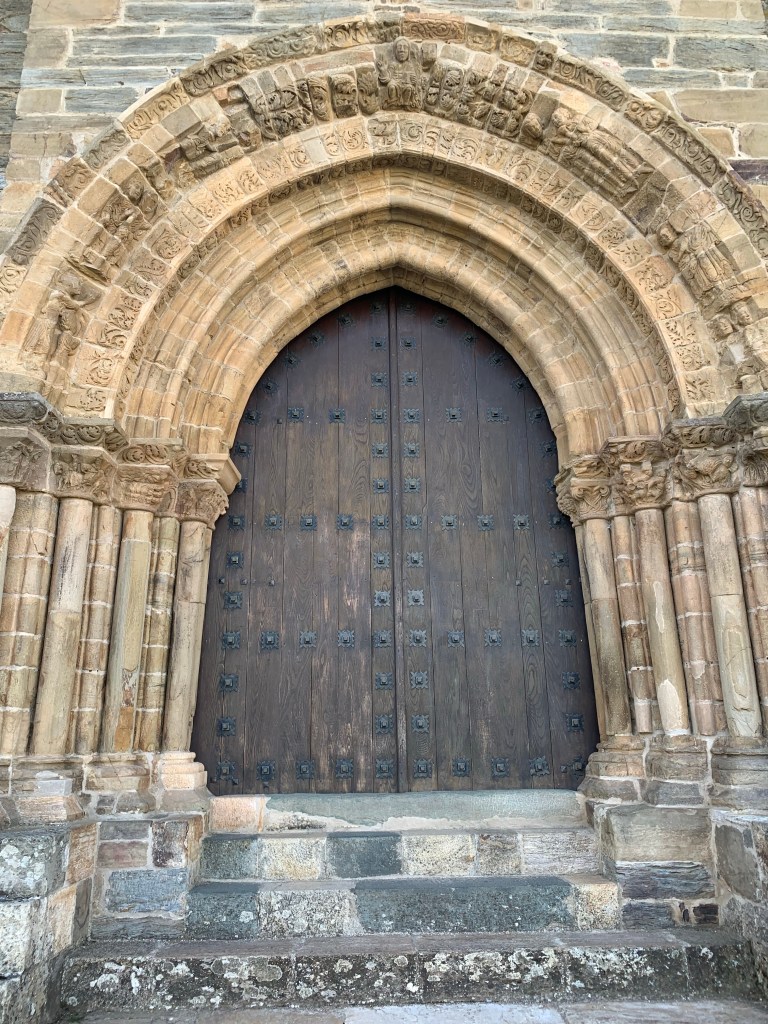
The terrain and flora continues to change as we march towards Galicia. We are in the region of Bierzo. surrounded on all sides by mountains. The economy, once driven by mining, is now based on agriculture. Bierzo wine, made with the locally grown mencia grape, is becoming popular – but I still prefer Rioja wines!Old house or new, their love their balconies in Bierzo. This is the Puerta del Perdon, where pilgrims long ago could be forgiven their sins if they could not make it all the way to Santiago. It is closed on Mondays, but you can be forgiven on the other days of the week by passing through this door.
The puerta above marked my arrival in Villafranca del Bierzo, the ancient capital of the region. I found my hostal on the opposite side of town. It is called Las Doñas del Portazgo and is a warm and welcoming place. Do you remember how, long after you had left home, and you went back and your Mom made you feel so good and comfortable? That’s how this place is.
I finally caught up with Lisa again. We had our “arrival beer”, then met later for dinner. We talked about our adventures and the people we had met and discussed plans for the next day.
I set off from Astorga, going past the Gaudí Episcopal church and the gothic Cathedral, which stand next to each other like an old man with his grandchild. This was day 23 on the road and the beginning of the ascent to the highest point along the Camino, marked by the Iron Cross at 1500m (just under 5000 ft). It is a gentle gradient and the aroma from the pine trees wafted through the air. The days on the meseta, the high flat ground, were over.
I reached Rabanal del Camino about 1 pm so I had an hour before I could check into the Stone Boat. Rabanal is a small town of fewer than 100 souls and it was not hard to find the one who ran the tavern. I sat outside in the warming sun and had a beer. The proprietor brought me fresh pears just picked from a wild pear tree.
Rabanal’s history pre-dates the Camino as it is located near Roman gold mines and may have existed when the Celtic tribes moved west. It was a busy stop along the early Camino where pilgrims could rest before making the final ascent that would take them to the Iron Cross. More recently, but before the advent of the train, Rabanal was a busy center of the mule trains that carried Galician products including seafood to the interior. Today, it is quiet, surviving only on the pilgrim trade.
I checked into the Stone Boat and met Kim, the owner and proprietor, an American woman from Key West. The Stone Boat is small – I think only 3 bedrooms with private bath – but very nice and inviting. Kim did everything to make my stay welcoming and comfortable, including arranging a massage with Priscilla just up the road. I am not a massage guy but I thought I should experience this treat and give my feet a soothing rub for having carried me this far. I also met Jody Lielidahl who checked in at the same time. He is a writer who grew up near Mamou Louisiana, where Paula and I witnessed a very traditional Mardi Gras many years ago. That night I went to the Benedictine monastery for vespers, chanted in Latin in the Gregorian style.
I returned to the Stone Boat to make an early night since I wanted to reach the Iron Cross at sunup. Kim was still there and wrapped a piece of zucchini cake for my breakfast the following day. Up in my room, somehow I knocked my glasses off, breaking the frame as the lens bounced off the tile bathroom floor. Would this be a good omen?
I got my early start. There was no moon out and the trees shielded any starlight from revealing the path. I focused my single eye on the path to avoid any rock or root lurking to trip me. After a while, I was well out on the trail. I looked up at the cloudless night sky and saw Orion on my left and the big bear on my right. Actually, I saw twice as many stars: one clear one and its fuzzy twin next to it. I do not use a flashlight or headlamp as many early-rising pilgrims. I figure the Camino will find me. We are so used to light in our lives that our night vision has suffered. My thoughts are very different walking in darkness as compared to during the day. I turned and noticed the sky reddening. I also saw the flicker of someone’s light and knew my nighttime reverie was about to end.
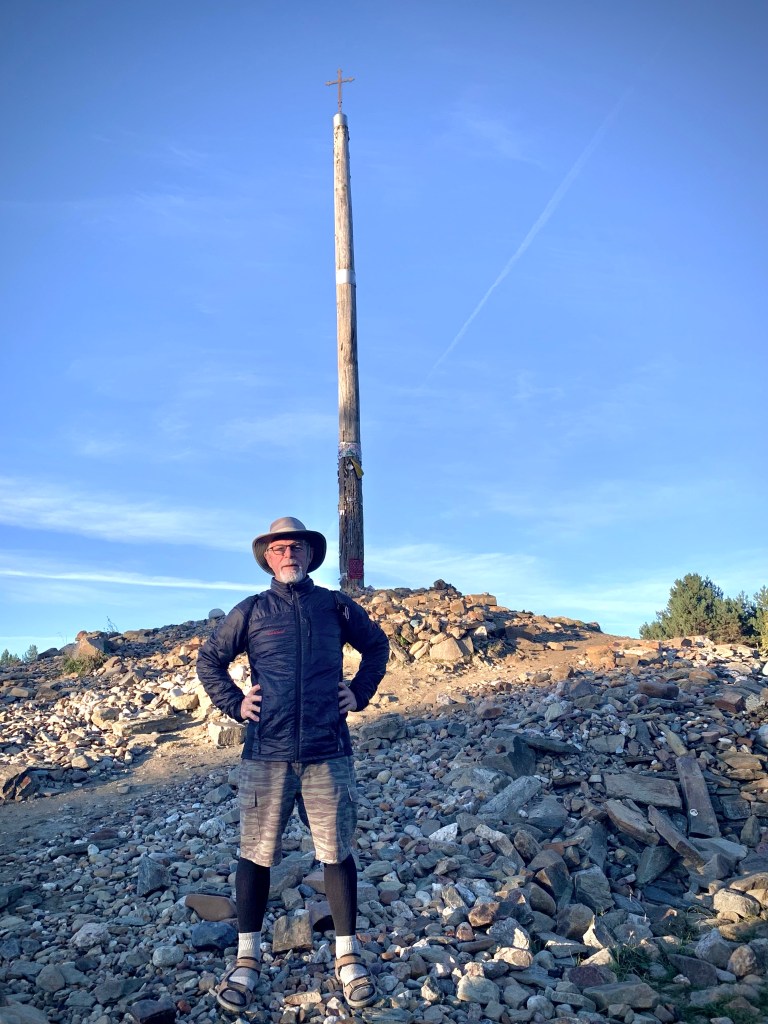
I hastened along my way, stopping for a coffee and Kim’s cake in Foncebadon before continuing on to the Iron Cross to deposit my rock which had travelled with from the Pacific Ocean near Encinitas. The day was lightening so I left my broken glasses in my pocket and went along my way.
In an hour I came upon this “food truck” and stopped for second breakfast. I have attached the video so you can hear the music playing. Sounds very Irish, but is Galician. Actually, Celtic. It is not surprising that the words Gaelic, Galicia and Gaul have the same ancient root. [The music is by Luar Na Lubre]
I completed the day’s stage arriving in Molinaseca after a treacherous descent starting just after El Acebo. The town is a cute but touristy town popular among pilgrims, cyclists and roadtrippers. It was tempting to stop for a cerveza but that would not have been helpful for the steep path ahead. In Molinaseca, I bumped into Francisco, Chris, Ignacio and Rafa. Ignacio told me that in the next town of Ponferrada there was a shopping center where I could possibly get my glasses repaired or replaced. After checking in to The Way hostel, I joined them in walking to Ponferrada, then bid them farewell as I departed for the shopping mall where I was able to get a temporary fix to my spectacles.
This post is already too long, so let me finish with this: the weather on my trek between Rabanal and Molinaseca was great. The sun shone with a passion and warmed up my bones which had not had a chance to thaw out on the chilly meseta. On my return from Ponferrada with vision now in both eyes, I took a taxi and asked the driver if this warm weather was normal. He told me they often have a few days to a week of warm weather in early October which they call el veranillo de San Miguel (San Martin sometimes gets the credit). It is what in the US might be called an Indian summer if we are still allowed to call it that.
I am taking a break in Molinaseca as I wait for Lisa. I may go back to Ponferrada to visit the Knight Templars castle or I might just hang out in Molinaseca.
The wind gods took a day off today. Yesterday, the trees waved their arms at me frantically. Today, they just stared as I walked by. I could feel the quiet, so much so that at one point I sat down on a rock on the side of the path, closed my eyes and listened for the silence. Not in prayer or meditation, but deep in thought. I could hear the occasional click-clack of hiking poles as a pilgrim went by and various other sounds that drifted by from afar. I thought about my parents and their parents and my children and their children. And how Paula and I are at this intersection of life through the ages.
These past few days have taken me through some rugged country. The farmers have a very difficult life tilling these rocky soils. The towns seem ghostly in the early mornings. Who lives here, I wonder. A small donativo I stopped in had skins on the floor as rugs. “Bears?” I asked, because they were quite large. “Javelina” was the reply. The javelina grow big eating corn in the maize fields. During harvest, as they try to escape, the farmers shoot them. Their bellies are full of corn. The young ones make a tasty treat. A donativo is a place where you pay what you can afford. A donation. Along the Camino, there are three types of accommodations: the donativo, where you pay what you can; the albergues, or hostels, where you find bunk beds to accommodate 6 or 8 or 10 people in a room, but some of which also have individual or double rooms often with a private bath; and then the hotels, which, depending on various factors, can be quite nice. This is me with Javier, who helps out at the donativo pictures above. This donativo in the countryside actually offered beds, but was mainly set up to serve food and drinks to the passing pilgrims. This one was nice, offering cheese, dried meats, fruits and melons, chocolate, nuts and more, as well as coffee and tea. They even had Yerba mate, as I was advised later by Christian, a pilgrim from Argentina.
Today was a short day, about 4 hours including a few breaks. I actually had a late start today because rain was forecast in the morning; it never came and the sunrise was glorious and it beckoned me on my way. I did run into a bit of rain, but did not need rain gear. The change in footwear helped and I enjoyed wearing sandals. I will wear sandals again tomorrow to Rabanal, and stay at the Stone Boat, which is my sister Katita’s favorite stop on the Camino.
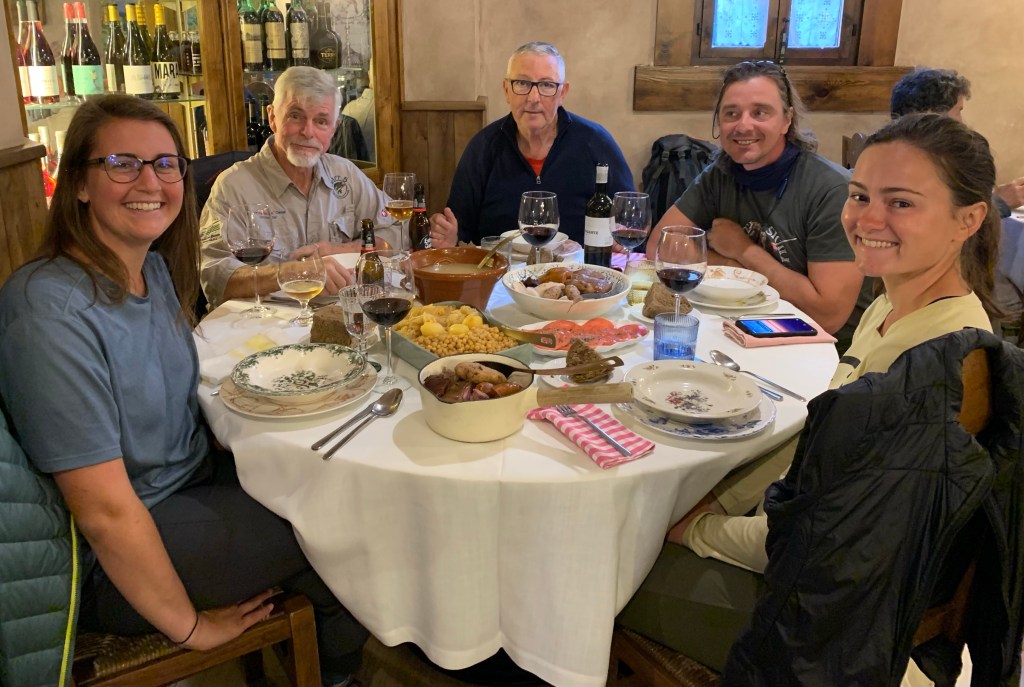
I ran into Francisco, he of the YouTube Camino channel and good deed and he invited me to lunch in Astorga at the Cocido Maragato restaurant. A cocido Maragato is a traditional dish of this region of Leon consisting of a broth with vermicelli noodles, garbanzo beans with boiled cabbage and potatoes and a variety of local sausages and meats, including morcilla, pork belly, chorizo, pigs ear and other tasty treats.
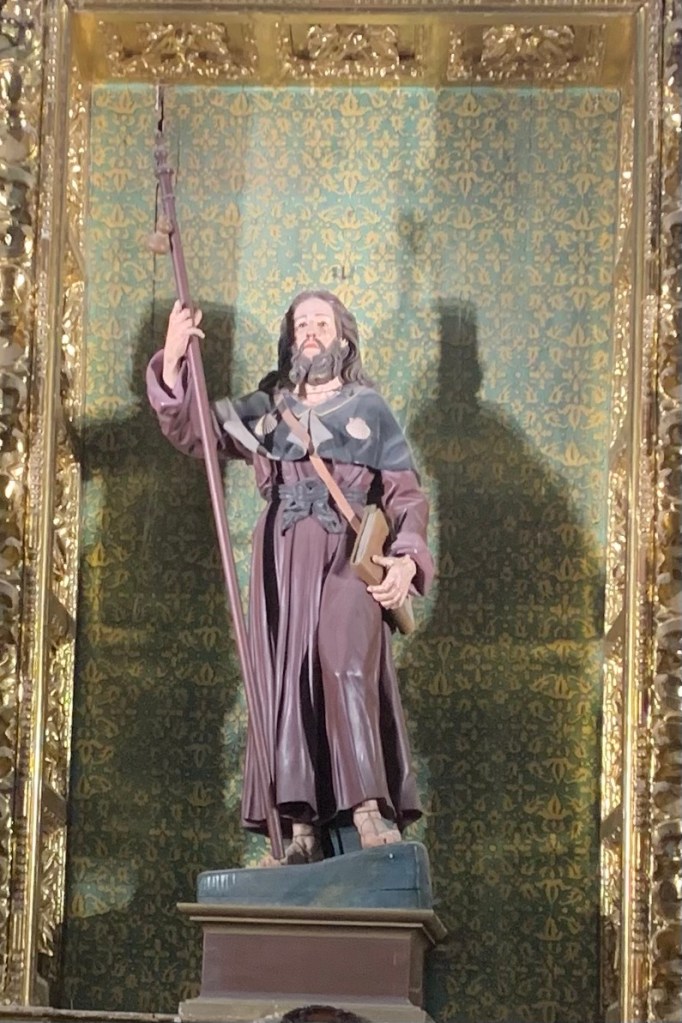
Francisco had also invited one of his Camino partners, Christian, the Argentinian (of German descent who works in Barcelona), and two young ladies he had been walking with for the past few days. They were Erin and Leanne, who Lisa and I met on day 2 or 3 of the Camino and have bumped into ever since. Lisa is a day behind me now after her break in Leon,. I told her if she wants to try the cocido maragato she had better bring four or five friends because this is definitely a community meal. I am still stuffed. I visited the cathedral after the big lunch and found a chapel dedicated to Santiago. The museum was interesting, but I preferred the Cathedral. It was built in the gothic style upon a Romanesque foundation and has been added to over the centuries with baroque and Renaissance influence.
First things first: I wanted to mention something that embodies the Camino spirit that I saw yesterday after arriving in Leon. I bumped into Francisco, the Youtuber from Almería, in a coffee shop. He was buying a coffee and pastry for some poor soul who obviously did not have the means to pay for it himself. He did it selflessly without drawing attention to himself. I now feel obliged to do a good turn myself. And so should you.
Lisa is taking a well- deserved day off today, so I set out early in the morning and played Camino hash: trying to find the path out of town. It is a little more difficult in the darkness of the early morning and there were not many peregrinos out that early. I figure Google-mapping is cheating, worthy of a serious offense if this were the HHH hash. Asking a local is a minor infraction at worst. I made my way out of town and just prior to leaving Leon’s city limits, I came across a small stand set up for serving hot coffee, bananas and other refreshments to pilgrims. All for the price of a donation. I had a coffee and took a banana and a delicious bar of dark chocolate. “Is it always this cold at this time of year?” I asked man running the stand. “No,” he replied, “it is usually colder!”
As I left the stand, it got colder, mainly because of a biting wind which grew stronger with every step away from Leon. I entered Virgen del Camino and found the alternative route I planned to take. The normal Camino runs alongside a major highway; the alternative goes through the countryside, first going south, then west and finally north, transecting the avoided highway and into Hospital del Orbigo where my hotel was.
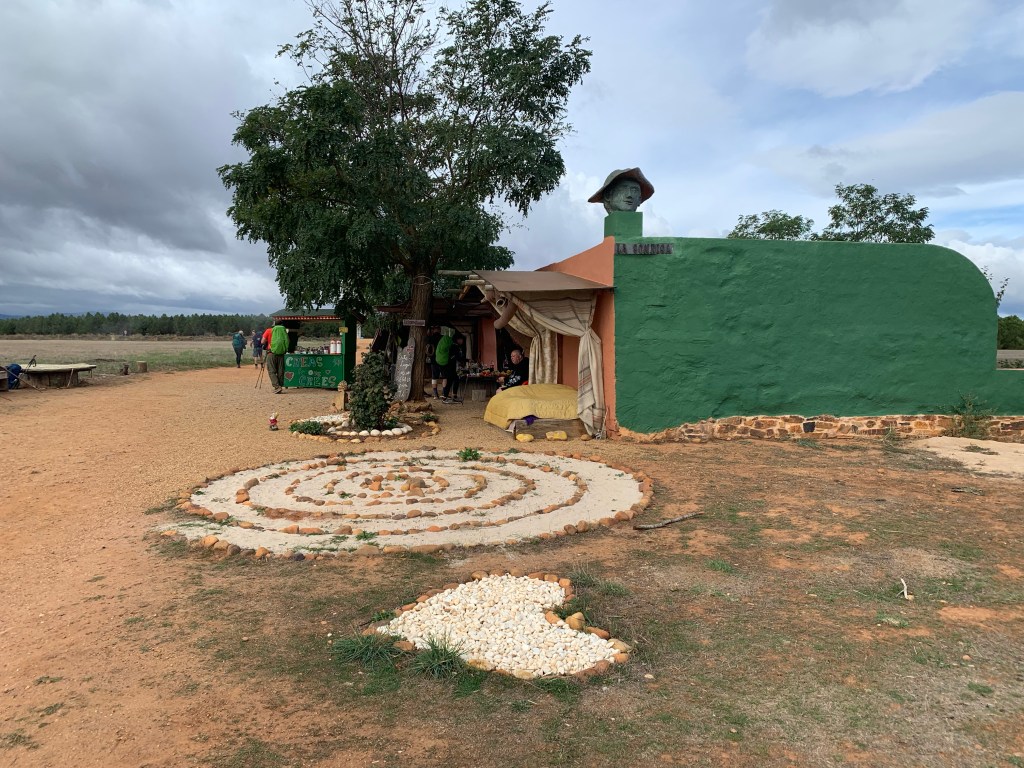
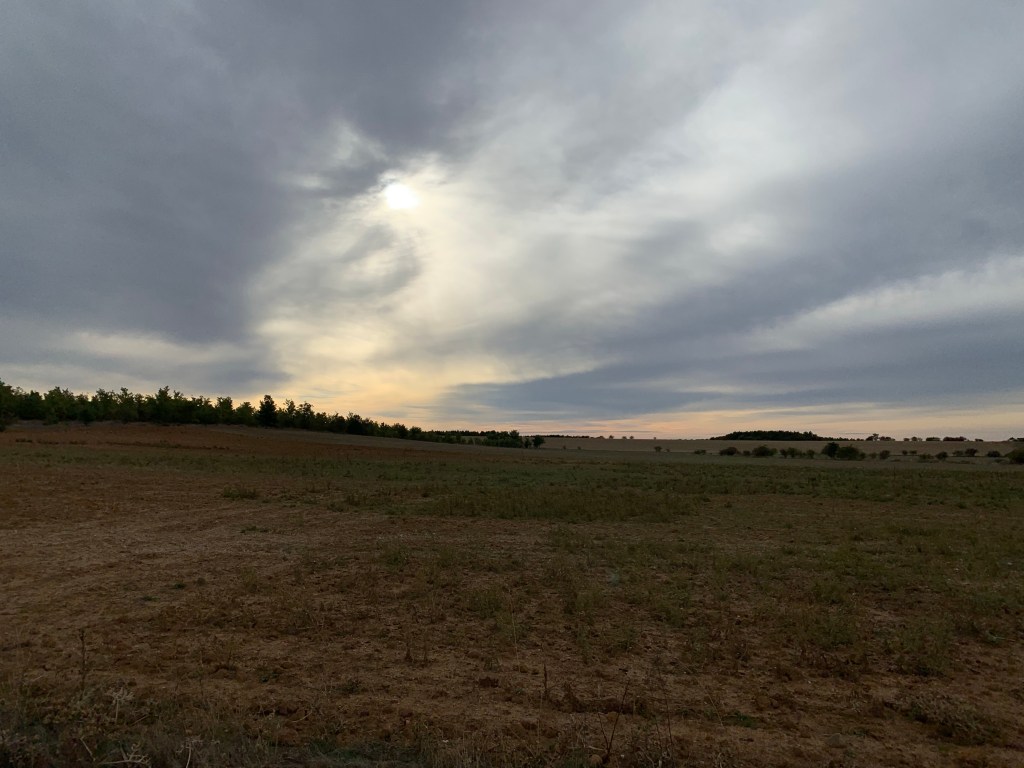
I had a nice cafe cortado and piece of homemade cake in Virgen del Camino and soon after I was in the countryside as the sun came up, promising a nice day – and some warmth. The sun could not penetrate the thick cirrus clouds and the wind blew constantly out of the mountainous north. A dozen wind turbines with Jack’s batteries could have powered Leon for a month. I came across this interesting structure exhibiting some truly Gaudí lines. It was billed as a Pilgrim’s Oasis. I am not sure if it was meant to be a bathroom for women, something that women will tell you is sorely missing from the Camino (has not been a problem for me!). I did not go in to investigate And so on I walked – and walked and walked in this windy high ground. I did not walk 25 miles, but it was more than 20! Note there are no shadows. The sun was stuck behind the thick layer of clouds. What a sight for sore feet. I followed the arrows which actually took me off the Camino but led to a bar where I had my breakfast: cafe con leche and a slice of tortilla. Then I was back on the windy way. The sun came out about noon so thought I would cool off my feet. I was feeling some hotspots and wanted to avoid blisters. I have taken to wearing knee-length compression stockings (with wool socks on outside) to help my feet but they are not the best for preventing blisters. I came across this monster blocking my path. This machine harvests the sunflowers.
The last hour always seems the longest, whether you target a four hour day or, like today, an 8 hour day. And then the last 1.5 km seems interminable! But before you can say “Hotel Don Suero de los Quiñones” you are there, checked in, showered and sipping a beer or a vino tinto. I was really looking forward to a gin and tonic, but it is too dang windy!
Judging from the menus dangling in front of a few establishments, sopa de trucha (trout soup) seems to be a local specialty. I was hoping to be sipping a piping hot sopa de trucha, but it is not served until 7 pm. Right now it is 6:15. It is only going to taste better!
A note on my feet: the swelling has subsided in my right foot, ankle and lower shin. Still tender in a few spots. My left ankle still gets sore as the day wears on; but I have some damaged tendons in my arch (from wear and tear over the years) which cannot be repaired out here. I have rubbed Voltaren on both feet every morning and most evenings for the last 3 days and have been wearing compression stockings. I also rub Aquafor on the soles of my feet and between my toes. As mentioned above, the stockings change the dynamic of my foot rubbing my shoe and both feet have hotspots. Tomorrow I will change to Aquafor, wool socks and sandals. I have a short day tomorrow: about 3 hours.
Okay, time for another vino tinto and my soup should be ready soon!
Leon is the last of the big cities before Santiago de Compostela. It was a nice walk from Mansilla de las Mulas. There is an alternate route that takes you on an ancient Roman road, which I kind of regretted not doing, until meeting the folks who had and their description of a long and desolate trail with no stops along the way and wobbly footing.
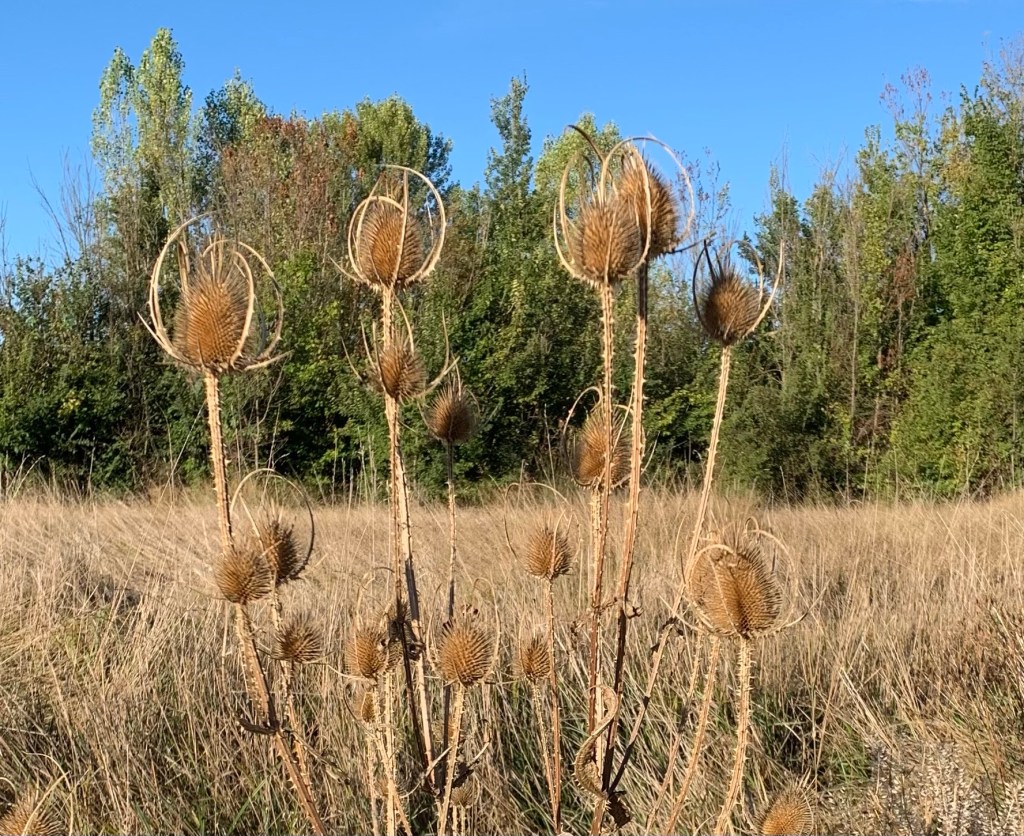
On the approach to Leon, I picked a thistle as a souvenir. I have seen them growing along the Camino since St Jean. It reminded me of Scotland, which reminded me of my good friend Doug Mowat. Doug entered his Santiago ahead of the rest of us, and I expect he will be there cheering us on as we reach that longed for destination. I remember talking about the things we would do in retirement. I am not sure if the Camino came up but I suspect Doug would have chosen the cycling route. Doug, today was for you!
Leon is a beautiful city and seems more compact than Burgos and more elegant than Logroño, but just as lively as Pamplona. Lisa and I visited the Cathedral which is a masterpiece. Surprisingly, when it was built, the population of the pueblo was about 5000 souls. Later we visited the museum at the Casa Botines, designed by Antoni Gaudí, the Catalan architect. Jack, you should take Shannon to visit this museum – it would amaze her I am sure. His masterpiece is the Sagrada Familia in Barcelona, but this museum describes his exploration of natural shapes to guide his designs.
The exterior of the Cathedral of Leon is even more beautiful at night. Close by is the Barrio Húmedo, or “wet neighborhood”, where there are a lot of bars. Lisa and I chose one and we had morcilla, scallops and gambas a la plancha, washed down with Rioja wine. As a digestif we tried an herbal orujo. Plain orujo is like grappa, which can be like firewater. With the herbal infusion, the orujo made a very pleasant end to our meal. On the way back to our lodgings, we bumped into more of our Camino family and had a nightcap with them.













 El Peregrino